At breakfast, my father announced that they had booked a dream trip to Italy for “just the six of us” and assumed that I would understand being left behind. I smiled and said nothing. That night, I froze the card after seeing $9,200 charged. By the next morning, at the airport, my mother texted asking why their boarding passes had disappeared.
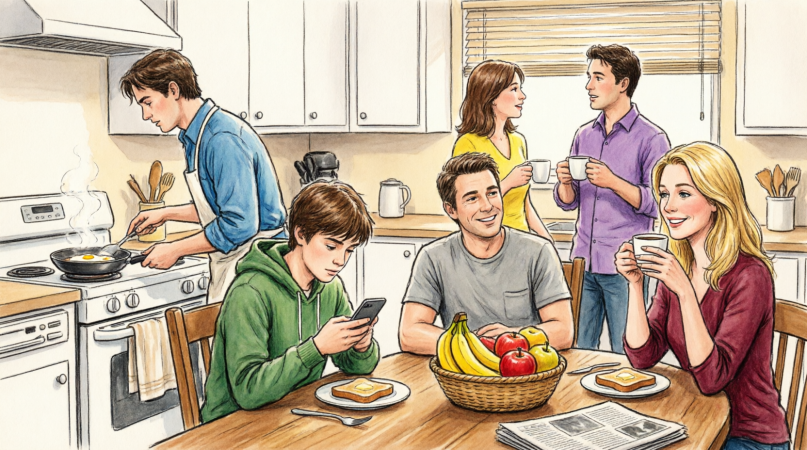
The kitchen in my parents’ Hinsdale estate smelled of rendered bacon grease, slightly charred sourdough toast, and the acidic, expensive bite of my mother’s dark-roast coffee. Outside, the morning light of an Illinois spring filtered through the custom plantation blinds in long, pale bars, striping the quartz countertops and the silver fruit bowl with a clinical precision. It caught the stack of unpaid utility mail on the corner of the island and the framed school pictures on the far wall—ghosts of a childhood that looked a lot more cohesive than it actually was. It was a room that should have felt like the warm heart of a family. Instead, it felt like a soundstage where everyone already knew their lines, and I was the only one who hadn’t been given a script.
My mother, Diane, nodded with a terrifyingly calm finality, as if the entire subject had already been settled by reasonable adults in some other, more important room I had simply failed to enter. Across from her, my sister Claire smiled into her fresh-squeezed orange juice, her eyes bright with the reflected light of the patio. Her husband, Caleb, laughed—a soft, comfortable sound that wasn’t intentionally cruel, but possessed that specific weight of someone who expects a bystander to absorb the awkwardness for them. My younger brother Mike didn’t even look up from his phone, his thumb flicking rhythmically through a sports feed, while his girlfriend, Tessa, leaned forward to ask whether the heat in Florence would still be unbearable in July.
“Six of us,” my father, Thomas, announced, his voice carrying the practiced authority of a man who spent his days managing regional logistics for a freight company. “Just the six of us. It’s the perfect number for the villas we’re looking at.”
He didn’t apologize. He didn’t offer an explanation or a justification. He simply tossed the phrase over the table like a used napkin, a clean efficiency of exclusion that was a trademark of the Mercer household. He looked at me for a split second, a silent command in his eyes that said: You get it. Don’t make this difficult. It was his way of ensuring there would be no messy conversation, yet still expecting me to perform the labor of making his decision feel civilized.
So I smiled. I have always been very good at making other people’s cruelty feel easy to live with. In the family architecture of the Mercers, I had been assigned a very specific job title years ago. I was Logistics. I was Emergency Funding. I was the Last-Minute Problem Solver equipped with a reliable car, a high-limit credit card, and the kind of inexhaustible patience that people only respect when they are planning to use it. My family did not think of me as someone who might be capable of being hurt. They thought of me as a utility—something that would simply adapt to the environment provided.
And I had adapted. For thirty-two years, I had been the shock absorber for their erratic lives.
The conversation at the table drifted away from me almost instantly, flowing into the easy, buoyant rhythms of vacation planning. They talked about the shimmering heat of Florence, the crowded romanticism of the Venice canals, and the heavy, red wines of Tuscany. Claire wanted to see the museums, but only “the pretty ones” that would look good on her social media feed. Caleb was already researching private tastings near Siena, talking about vintages and terroir as if he were the one who had earned the money for the trip. My mother started scribbling a list of travel-size toiletries on the back of a grocery receipt, her mind already three thousand miles away. Mike called the window seat. Tessa laughed at something he whispered in her ear.
No one asked whether I minded staying behind. No one performed the minor, polite courtesy of pretending they wished things were different. I sat there in the striping light, a ghost at my own family’s breakfast table, watching the version of a life they were building without me.
By the time I finally excused myself, my coffee was stone cold and my jaw ached from the sheer physical effort of maintaining that effortless, supportive smile.
I drove back to my condo in downtown Chicago, the skyline rising up like a wall of grey glass against the humid horizon. I kept the jazz on low volume, trying to drown out the silence, while my prosthetic leg ached where the carbon-fiber socket always tightened in the summer humidity. I had lost the limb in a freak accident three years ago, a moment that had only reinforced my family’s view of me: I was the one who survived, the one who worked, the one who didn’t complain. I kept waiting for anger to arrive in some dramatic, cinematic form—shaking hands, hot tears, or the sharp, familiar sting of childhood rejection.
Instead, what arrived was something much colder. Clarity.
They hadn’t excluded me because of the cost of an extra ticket. They hadn’t excluded me because of a lack of space in the villas. They hadn’t even forgotten me. Leaving me behind had become a structural necessity for them. My absence was load-bearing; it allowed them to be the “perfect” version of themselves without the reminder of the brother who actually held the floorboards together.
That night, I was sitting at my mahogany desk, halfway through answering a mountain of late-night work emails, when my phone buzzed with a sharp, insistent fraud alert from my bank.
At first, I almost swiped it away, thinking it was a glitch. But then I looked down and saw the numbers, and the breath left my lungs in a cold rush.
$1,860 — a boutique hotel in Rome. $2,400 — a private, luxury canal tour in Venice. $1,175 — a high-end restaurant charge in Florence.
The notifications kept coming, a rhythmic pulse of audacity. Another hotel. Another meal. Another pre-booked excursion. They were running the entire “dream trip” through the emergency card I kept in my father’s name for “catastrophes”—the one I had opened years ago to ensure they were never stranded or helpless.
I sat very still in the quiet of my apartment.
I opened the banking app, my fingers moving with a clinical, detached precision. There they were, lined up in neat, confident rows. Each charge was more arrogant than the last. They hadn’t merely decided to exclude me from Italy; they had decided, with a breathtaking lack of shame, that I would be the one to quietly fund the version of the trip where my absence made everything simpler. No one had asked. No one had warned me. There had been no awkward text, no half-hearted “we’ll pay you back” lie. Just the old, ingrained family belief that if I wasn’t invited to the party, I should at least be honored to pay for the catering.
I stared at the screen until the blue light felt like it was burning into my retinas.
Then, I began to tap.
Hotel. Unauthorized. Tour. Unauthorized. Meal. Unauthorized. Excursion. Unauthorized.
One after another, I marked every single charge as fraudulent. I froze the card and locked the primary account so fast it felt less like an act of revenge and more like a surgical extraction—removing my hand from a flame I had been holding for decades. There was no shouting into the void. No dramatic speech. No frantic text thread to the family group chat. Just a series of calm, decisive taps in a silent apartment, thirty thousand feet, emotionally, away from the breakfast table in Hinsdale.
Then I closed the app and waited.
That was the part that mattered most. My family knew how to handle an argument. They were experts at guilt-tripping, at atmospheric pressure, at crying and denying and rewriting history until the truth was a blur. But they didn’t know how to handle silence. Silence would make them invent their own worst-case scenarios. Silence would leave them alone with the cold reality of logistics.
At 4:12 a.m., as they were standing at the check-in counter at O’Hare, surrounded by their designer luggage and the hollow expectation of a dream, the first text from my mother arrived.
“Evan, why did our digital boarding passes just vanish from the app? We’re at the gate and the agent says the booking is ‘invalid.’ Call me immediately.”
I looked at the message for a long, quiet moment, watching the sun begin to touch the Chicago skyline. Then, I typed the only answer they had earned.
“I’m not on the trip.”
The phone on my nightstand didn’t just buzz; it screamed.
It was 4:18 a.m. In the high-rise silence of my condo, the sound was jagged and intrusive. I didn’t pick up. I sat up in bed, the cool Chicago air pressing against my skin, and watched the screen light up with a frantic succession of names. Mom. Dad. Claire. Mike. It was a digital roll call of the people who had looked through me over bacon and eggs just twenty-four hours ago.
I walked to the kitchen and started the espresso machine. The hiss of the steam was the only thing I wanted to hear.
A new text came through, this one from my father. The tone had shifted from confusion to the cold, low-frequency command he used when a shipment was delayed at work.
“Evan, stop playing games. We are at the Alitalia counter. The agent says the payment for the entire six-person booking was ‘reversed’ by the cardholder. The rooms in Rome have been cancelled. Fix this now. We have a flight in fifty minutes.”
I took a slow sip of the espresso. I could almost see them. My father, his face turning that specific shade of brick-red that signaled his blood pressure was redlining. My mother, Diane, clutching her designer carry-on, her eyes darting around to see if any of their Hinsdale neighbors were witnessing the humiliation. Claire and Caleb, probably leaning over the counter, trying to use “influencer” logic on a tired airline employee who didn’t care about their follower count.
I didn’t call. I didn’t fix it. I sent a single, clinical reply to the group thread.
“The card was flagged for unauthorized activity. I didn’t book a trip to Italy. Since I’m not on the itinerary, the bank assumed the charges were fraudulent. I’ve confirmed the freeze. Have a safe flight.”
The explosion was instantaneous. My phone began to vibrate so violently it skittered across the marble countertop.
I finally answered my father’s tenth call.
“Evan!” he roared, his voice competing with the hollow, rhythmic echoes of the airport PA system. “What the hell is wrong with you? Do you have any idea what’s happening here? They’ve taken our bags off the belt! They say the tickets are void! You didn’t ‘flag’ anything—you did this on purpose!”
“I did exactly what a responsible cardholder does, Dad,” I said, my voice as level as a horizon line. “I saw nine thousand dollars in international travel charges that I didn’t authorize. Since I’m not part of the ‘six of us,’ those charges aren’t mine to carry. It’s a simple matter of accounting.”
“Evan, don’t be a child!” Claire’s voice shrieked in the background, having clearly snatched the phone. “We’re supposed to be in Rome by dinner! Caleb has a tasting booked! Do you really want to ruin everyone’s summer because you’re throwing a tantrum over an invitation?”
“It’s not a tantrum, Claire,” I said. “A tantrum is what you’re doing in the middle of Terminal 5. This is a business decision. You all decided I was the ’emergency fund,’ but you forgot that the fund has a manager. And the manager is staying home.”
“Fix it!” my father barked back into the receiver. “Use your personal line. Call the bank and authorize the ‘unauthorized’ charges. We’ll settle up when we get back. I’ll write you a check. Just get us on that plane!”
“You don’t have the money for a nine-thousand-dollar check, Richard,” I said, using his first name for the first time. The silence on the other end was sudden and brittle. “If you did, you wouldn’t have run the deposit through my emergency card without asking. You spent the last of your liquid cash on the new patio furniture last month. We both know it.”
“Evan, please,” my mother’s voice came through now, soft and pleading, the tone she used when she wanted me to ‘understand’ why I was being left out. “Think of Mike and Tessa. They’ve been looking forward to this for months. Tessa bought all new luggage. Don’t punish them for our oversight.”
“It wasn’t an oversight, Mom,” I said, looking out at the city as the first light of dawn hit the Sears Tower. “It was an assumption. You assumed I would be the floorboards again. But the thing about floorboards is, if you walk on them too hard while telling them they don’t belong in the house, eventually they just… stop holding you up.”
“Is that your final word?” my father asked, his voice shaking with a cold, impotent fury. “You’re going to let us stand here and watch that plane leave?”
“I’m not letting you do anything,” I said. “You’re adults. You have your own cards. You have your own credit. Use them. Unless, of course, they’re already maxed out from the ‘lifestyle’ you’ve been maintaining.”
I hung up.
I walked to my balcony and watched the sun climb. Twenty minutes later, the fraud alert app on my phone pinged again. Someone was trying to run the card at the airport kiosks. Denied. Then a hotel portal in Rome tried again. Denied.
They were desperate now. They were realizing that the “clean efficiency of exclusion” worked both ways. They had left me behind to make the trip “simpler,” but they had forgotten that without the person who manages the complications, there is no trip. There is only a group of people standing in an airport in the dark, clutching boarding passes that don’t exist.
The silence in my condo for the next three hours was a heavy, pressurized thing. I didn’t turn on the news. I didn’t check the flight trackers to see if Alitalia Flight 629 had departed for Rome without them. I simply sat at my kitchen island, the “Sponsor” of a ghost trip, watching the shadows of the skyscrapers shorten as the morning matured.
At 8:44 a.m., the front door buzzer of my building didn’t just ring; it snarled.
“Mr. Mercer,” the concierge’s voice came through the intercom, sounding rattled. “Your parents and sister are downstairs. They are… extremely distressed. They’re claiming there’s a medical emergency, but they’ve brought their luggage into the lobby.”
“It’s not a medical emergency, Marcus,” I said, my voice like cold iron. “It’s a financial one. Send them up. But tell security to keep a close eye on the hallway cameras. I don’t want any ‘spontaneous’ property damage.”
Two minutes later, my front door was kicked back against the stopper.
My father stormed in first, still wearing his travel blazer, his face a mottled, dangerous shade of purple. Behind him, my mother looked like a woman who had just survived a shipwreck—her hair disheveled, her expensive silk scarf hanging limp. Claire followed, her eyes red-rimmed and vibrating with a frantic, narcissistic rage.
“You’re a sociopath!” Claire shrieked before the door had even clicked shut. “We stood there like criminals, Evan! The gate agent called security because Caleb tried to ‘reason’ with them! They treated us like we were using stolen cards! Do you have any idea what it’s like to be escorted out of an international terminal by men with rifles?”
“I think I do,” I said, not rising from my chair. “It sounds a lot like the feeling of being excluded from a family breakfast while everyone discusses a dream trip on your dime.”
“We were going to pay you back!” my mother wailed, dropping her carry-on in the middle of my minimalist living room. “We just needed the points! Your father’s liquidity is… tied up in the home equity right now. It was just a temporary bridge, Evan! You know how we do things!”
“I know exactly how you do things, Diane,” I said, using her first name to underscore the distance. “You do things with other people’s labor. You do things with other people’s patience. And you do things with my credit score because you’ve spent thirty years pretending that ‘Hinsdale prestige’ is a currency. It isn’t. It’s a debt.”
“Shut up!” my father roared, slamming his hand onto the glass dining table. “You’ve humiliated me for the last time. I gave you everything. I put you through school. I paid for that prosthetic when the insurance company dragged their feet. And this is the thanks I get? A knife in the back at the airport?”
I stood up then. I didn’t rush. I leaned on my good leg, my prosthetic clicking softly into place—a sound that usually went ignored in our house.
“You didn’t pay for this leg, Richard,” I said, my voice dropping into a low, lethal hum. “I paid for it with the settlement from the trucking company that hit me. And I paid for your school ‘loans’ too—the ones you took out in my name while I was in rehab and ‘forgot’ to tell me about until the collection calls started. I’ve been the one holding the floorboards up since I was twenty-two.”
“Evan, please,” my mother whispered, sensing the shift in the room. “The kids… Mike and Tessa are devastated. They’re sitting in the car right now, crying. They had their whole summer planned. Just… just call the bank. Tell them it was a misunderstanding. We can still get a flight out tonight. We’ll pay for the rebooking fees.”
“There is no ‘we,’ Diane,” I said. “There is the ‘six of you’ who booked a trip to Italy. And then there is me—the person who isn’t on the trip. Since I’m not on the itinerary, I’m not on the bill. It’s the clean efficiency of exclusion, remember? You taught me that at breakfast.”
“You’re going to watch us lose the deposits?” Claire hissed, stepping forward. “Thousands of dollars in non-refundable villa fees? You’re going to let that money just vanish because your feelings are hurt?”
“I’m not letting it vanish,” I said, picking up my phone and sliding a digital document across the table. “I’ve already contacted the villa owners in Siena and the hotel in Rome. I told them the charges were fraudulent. They’ve already initiated the clawback. The money isn’t vanishing, Claire. It’s coming back to me. Every single cent.”
The silence that followed was absolute. It was the sound of a family realizing that the ATM had not only stopped dispensing cash—it had started demanding the previous withdrawals back.
“You’re a monster,” my father whispered, his voice cracking.
“No,” I said, walking toward the door and opening it wide. “I’m logistics. And today’s logistics suggest that the Mercer family is staying in Illinois for the summer. I hear the heat in Hinsdale is quite lovely in July. You can see all the ‘pretty’ things from your own patio.”
As the elevator pinged in the hallway, I watched them retreat—not as a cohesive family unit, but as a collection of people who had finally realized they were standing on a foundation they never bothered to pay for.
By 2:00 p.m., the digital siege began.
I sat in my office, the rhythmic hum of the Chicago skyline vibrating through the floor-to-ceiling glass, but my attention was fixed on a series of notifications that felt like a localized cyber-attack. It wasn’t my bank this time. It was Facebook. It was Instagram. It was the “Hinsdale Living” private group—the digital town square where reputations were forged and destroyed over morning mimosas.
Claire had shifted tactics. Since the physical ambush in my condo had failed to loosen my wallet, she had decided to weaponize the one thing my mother valued more than luxury: our family’s public standing.
The first post was a photo of the group at O’Hare, looking bedraggled and tragic next to a pile of expensive luggage. The caption was a masterpiece of suburban manipulation: “Heartbroken. A dream family trip to Italy, months in the making, cancelled at the gate because of a ‘technical glitch’ orchestrated by someone we trusted. Watching my parents’ faces fall was the hardest thing I’ve ever seen. Success shouldn’t cost you your humanity. #FamilyBetrayal #HinsdaleStrong #BrokenPromises”
I leaned back, my chair creaking in the silence. It was calculated. Within thirty minutes, the comments were a hornet’s nest of pearl-clutching neighbors and distant relatives who had never paid a single one of my father’s “bridge loans.”
“Unbelievable! Diane is such a pillar of this community!” one read. “How can someone with that penthouse let their own parents suffer like that?” asked another.
Then came my mother’s contribution. A “Story” on Instagram—a photo of the empty breakfast table from yesterday, the pale bars of light hitting the spot where I usually sat. No words. Just a broken heart emoji and a link to a generic article about “The Pain of Elder Financial Abandonment.”
My phone buzzed. A text from an unknown number. It was Caleb, Claire’s husband—the man who lived for private tastings and silent assumptions.
“Evan, look. This is getting out of hand. The publicity is damaging your father’s standing with the country club board. They’re talking about a ‘character review.’ Just authorize the rebooking for the flight tonight. We’ll sign a promissory note for the villa fees. Let’s be adults and take the posts down before this goes permanent.”
I didn’t reply to Caleb. I didn’t comment on the posts. I didn’t engage in the digital mud-wrestling they were so clearly craving. Instead, I opened a secure file on my desktop labeled “Mercer Family Ledger 2021-2026.”
If they wanted a public trial, I would provide the discovery.
I spent the next hour compiling a very different kind of digital gallery. I pulled the bank records for the “emergency” card, highlighting the nine thousand dollars in unauthorized luxury travel. I pulled the screenshots of the flight itinerary that explicitly listed “Six Passengers” by name, with mine conspicuously absent. I even pulled the 2023 tax records showing the “tuition” payments I had made for Mike’s final semester—money he had actually spent on a jet-ski he kept at a “friend’s” house in Lake Geneva.
I didn’t post them to Facebook. I wasn’t that reckless.
I sent a single, encrypted PDF to the entire Mercer family group chat. The cover page read: NOTICE OF DISPUTED LIABILITIES.
“To Claire, Diane, and Richard,” I typed. “The narrative you are spinning online is a fascinating work of fiction. However, as the ‘logistics’ provider for this family, I have kept meticulous records of where every dollar has gone. If the social media posts regarding my ‘betrayal’ are not removed by 4:00 p.m., I will release this document—including the unauthorized Italy charges and the Lake Geneva jet-ski receipts—to the same neighborhood groups you are currently soliciting for sympathy. I will also forward it to the country club board to assist with their ‘character review.’ I am no longer a brother. I am a forensic auditor. And auditors don’t care about your hashtags.”
The silence that followed the “Read” receipts was the loudest sound I had ever heard.
At 3:42 p.m., the Facebook posts vanished. The Instagram story was deleted. The “Hinsdale Living” group went quiet, moving on to complain about a local zoning ordinance.
My phone rang. It was Claire. She wasn’t screaming this time. She sounded like a cornered animal realizing the cage was made of steel.
“You wouldn’t,” she whispered. “You wouldn’t humiliate Mom like that. You’d be destroying the family name. Your name, too.”
“My name is built on my work, Claire,” I said, looking out at the red sun dipping behind the Sears Tower. “Your name is built on my credit. There’s a difference. You told me to ‘understand’ being left behind. Well, I understand perfectly now. You wanted the vacation, but you didn’t want the cost. Now, you’re paying the highest price of all: the truth.”
“What do you want?” she asked, her voice cracking.
“I want you to stay in Hinsdale,” I said. “I want you to look at those packed suitcases in the foyer and realize they aren’t going anywhere. And I want you to tell Mike to sell the jet-ski. He’s going to need the money for his own rent next month, because the ‘Emergency Fund’ is officially closed for the season.”
I hung up.
 :
: