“No,” Mason said immediately.
“I asked your wife.”
Khloe’s eyes filled.
Mason leaned over the table. “This is insane.”
Angela spoke calmly. “The SUV is registered to a shell company connected to a man named Darren Vale. Mr. Vale has a history of staged accident claims. He received a payment two days before Mrs. Hart’s crash from an account linked to Khloe Hart’s consulting business.”
Mason turned slowly toward his wife.
The flowers slipped from his hand and fell onto the floor.
Khloe began shaking her head. “No. It wasn’t supposed to happen like that.”
The words left her mouth before she could stop them.
Mason whispered, “Khloe.”
I gripped the back of the chair.
The room tilted, but not from my concussion.
“What was supposed to happen?” I asked.
Khloe’s tears came quickly now. Real tears, I think, but not for me. For herself. For the story collapsing. For the fact that she had stepped into my kitchen and found witnesses waiting.
“I didn’t know he would hit you that hard,” she whispered.
The world narrowed to her face.
Mr. Beckett said nothing.
Angela said nothing.
Mason looked as if he had stopped breathing.
Khloe covered her face. “It was just supposed to scare you. Delay you. Mason said you were going to sign something with Margaret’s attorney and that once you did, everything would be locked away.”
Mason exploded. “I never said to hurt her!”
I stared at him.
The sentence told me too much.
Not What are you talking about?
Not I didn’t know.
Not Mom, I would never.
I never said to hurt her.
“So you knew,” I said.
His eyes snapped to mine, desperate now. “I knew she was trying to find out about Aunt Margaret’s estate. I didn’t know about a crash.”
Khloe sobbed, “You said we had to stop her from signing before we knew what was in it.”
“I meant talk to her!”
“You said she never listens unless something forces her!”
“That doesn’t mean hit her with a car!”
I sat down slowly.
My knees had weakened.
For one strange second, I noticed the tiny domestic details around me: the ceramic rooster on the counter, the grocery-store flowers on the floor, the spoon rest beside the stove, the soft hum of the refrigerator. How could a kitchen remain a kitchen while a family died inside it?
Mr. Beckett’s voice was careful. “Mrs. Hart, do you want to continue this conversation here?”
I looked at Mason.
His eyes were wet now.
“Mom,” he said.
I had heard that word from him in every possible tone over forty years. Sleepy toddler. Angry teenager. Laughing young man. Tired father. This tone was new. Begging, but not only for forgiveness. Begging for time to rearrange the truth before it hardened.
“No,” I said.
He flinched.
“No what?”
“No, you don’t get to speak first anymore.”
Angela stepped slightly closer to the table. “Mr. and Mrs. Hart, you need to understand that any further statements may have legal consequences. Law enforcement has already been notified regarding the vehicle and payment trail.”
Khloe gasped. “Police?”
“Yes,” Mr. Beckett said.
Mason looked at me as if I had betrayed him.
That was when whatever remained of the old mother in me finally sat down.
“You asked about my assets while I was in the hospital,” I said quietly. “You didn’t come. You didn’t call to ask if I needed help getting home. You waited weeks, then came with flowers after your wife realized something had gone wrong with whatever plan you had made. And now you want to look at me like I’m the one who crossed a line?”
His face crumpled.
“I didn’t know, Mom.”
“You knew enough.”
He reached toward me.
I pulled back.
Khloe made a small broken sound. “Evelyn, I’m sorry.”
I looked at her.
“For what? The crash? The payment? Or getting caught?”
She cried harder.
Mr. Beckett closed his portfolio. “I think it’s time for you both to leave.”
Mason did not move.
“I need to talk to my mother.”
“No,” I said. “You need to talk to an attorney.”
The police arrived twenty minutes later.
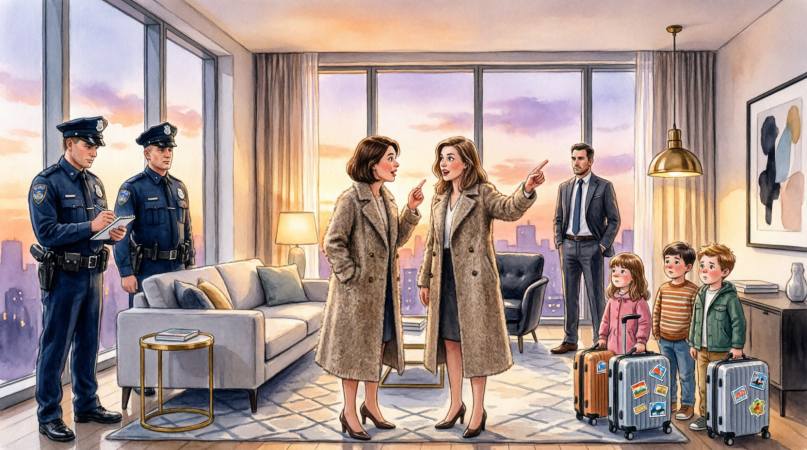
That is not something I ever imagined saying about my son. Two officers in my kitchen, one taking notes while Angela provided documents and Mr. Beckett spoke in precise legal language. Khloe kept crying. Mason kept insisting he did not know the accident would happen. Every denial revealed another layer of knowledge. He knew I was going to sign documents. He knew Aunt Margaret had left something. He knew Khloe had contacted someone to “slow things down.” He claimed he did not know money changed hands. Khloe claimed he knew everything except the method. The truth sat between them like a knife neither wanted to pick up.
They were not arrested in my kitchen that day. Real life is not always theatrical enough to satisfy pain. But their phones were taken later. Search warrants followed. Darren Vale, the driver, was picked up first. He was not loyal. Men hired to do ugly things for money often become very talkative when prison enters the room. He said Khloe paid him to cause a “minor collision,” enough to scare me and delay my appointment. He said she gave him my route. She claimed Mason provided it. Mason said he only mentioned where I was going because he thought Khloe wanted to send flowers.
Flowers.
That word almost made me laugh when Angela told me.
The case took months to untangle. Conspiracy, insurance fraud, assault by vehicle, financial exploitation, attempted interference with estate proceedings. Lawyers shaped words carefully. Prosecutors weighed intent. Khloe’s business account created a trail she could not explain away. Mason’s messages showed resentment and urgency, but not a direct order to cause the crash. It mattered legally. It mattered less to me.
He had known enough to not warn me.
He had known enough to wait.
And when the hospital called, he had asked about assets.
Khloe pleaded first. Darren Vale took a deal. Mason fought longer, perhaps because he still believed he could explain his way back into being my son without consequence. In the end, he accepted a plea tied to conspiracy and obstruction. Khloe received the harsher sentence. Mason did not go to prison for as long as some people thought he should. He did not walk free either.
I attended one hearing.
Only one.
Mason turned when I entered the courtroom. He looked thinner, older, stunned by the sight of me upright and steady. Khloe sat beside her attorney, eyes red, hair pulled back, no polished smile left. When the prosecutor described the crash, my ribs ached as if my body remembered for the court.
Mason asked to speak before sentencing.
His attorney looked nervous, but the judge allowed it.
He stood, hands trembling.
“Mom,” he said, turning toward me.
The judge reminded him to address the court.
He swallowed.
“I told myself I was protecting my family. My wife, my son, our future. I told myself my mother would understand once everything was sorted out. I told myself a lot of things because I didn’t want to admit I was waiting to benefit from her death.”
A sound moved through the courtroom.
I closed my eyes.
There it was.
The truth.
Ugly. Late. Smaller than the damage. But truth.
He continued, voice breaking. “I didn’t want her hurt. But I didn’t protect her. I didn’t come when she needed me. I asked about money when I should have asked if she was scared. I don’t know how to apologize for that.”
Neither did I.
After the hearing, I did not wait for him.
Mr. Beckett walked me to the car.
“You handled that with grace,” he said.
“No,” I replied. “I handled it without collapsing. That’s not the same thing.”
He smiled sadly. “Sometimes it is close enough.”
The inheritance became real slowly after that.
Thirty-eight million dollars does not feel like freedom when it enters through a door opened by betrayal. At first, it felt like evidence. Motive. Danger. Then, with time, it became responsibility. Aunt Margaret’s properties needed management. Her investments needed structure. Her house in Winter Park needed decisions. Mr. Beckett helped me assemble a team that did not speak to me like a confused widow who had stumbled into money by accident. I created trusts, updated beneficiaries, secured everything behind layers of protection Mason would never have access to.
I sold nothing for a year.
I needed to understand what I owned before deciding what I owed.
Eventually, I created the Margaret Hart Foundation for Elder Financial Safety. We funded legal assistance for seniors facing exploitation by relatives, emergency banking reviews, notary fraud prevention programs, and hospital advocacy for older adults whose “concerned family members” showed up only when assets were mentioned. Denise, the nurse who had told me what Mason asked, became the first person I invited to advise the hospital partnership. She cried when I told her why.
“You believed me before I knew how much I needed it,” I said.
She said, “You looked like someone whose world had just cracked.”
“It had.”
Mason wrote letters.
For the first year, I did not answer. Mr. Beckett screened them first, then sent them to me if they contained no requests, no manipulation, no legal bait. At first, they were full of explanation. Then remorse. Then memory. He wrote about being a boy and holding my hand. He wrote about the moment in the hospital call when he asked about assets and heard himself become someone he did not recognize. He wrote that Khloe had fed his resentment, but he had supplied it willingly. He wrote that he missed being my son before money turned him into a stranger.
I read every letter.
I kept them in a drawer.
Not because they healed me.
Because they were part of the record.
Aiden, my grandson, was too young to understand at first. That was the cruelest part. Mason and Khloe’s choices spilled onto a child who had done nothing but love the adults around him. Through attorneys and social workers, arrangements were made. I saw Aiden in supervised settings at first, then more often once guardianship issues settled with Khloe’s sister. He would run into my arms and ask why Daddy was away. I never told him more than a child could carry.
“Daddy made some bad choices,” I said once.
“Will he make good ones later?” Aiden asked.
I looked at his small face and felt the old mother in me stir, wounded but still alive.
“I hope so,” I said.
And I meant it.
Hope did not mean access. Hope did not mean forgetting. Hope did not mean handing Mason keys to my life again. It meant leaving one small light on somewhere far away, not for him to follow back whenever he pleased, but for the possibility that one day he might become a man who could stand in its glow without trying to own it.
Years later, people in my neighborhood still talk about the crash, though never directly to me unless they are brave or rude. They know some version of the story. Widow inherits fortune. Son doesn’t visit. Daughter-in-law involved in accident scheme. Lawsuits. Foundation. Courtroom tears. People love dramatic summaries because they make pain feel like entertainment that happened safely to someone else.
But that is not the real story.
The real story is a woman sitting alone in a hospital bed waiting for her son.
The real story is a nurse choosing honesty.
The real story is a kitchen where a daughter-in-law whispered, “She knew,” and accidentally gave shape to everything I had been afraid to name.
The real story is that I had spent my life believing love meant making things easier for Mason, and he had learned, somewhere along the way, to believe my life itself was something that could be made useful.
I still live in the yellow house outside Orlando. I could live anywhere now, but I stayed. I replaced the old mailbox. I fixed the cracked tile near the back door. I planted hibiscus along the fence and had the screened porch repaired so I could sit there during summer storms. Aunt Margaret’s Winter Park house became the foundation office. Her money moves now, but carefully, toward people who need protection from the kind of betrayal that wears a familiar face.
Sometimes, when the afternoon light turns bright and hard like it did on the day of the crash, my body remembers before my mind does. My ribs ache. My wrist stiffens. I hear metal. I smell airbag dust. Then I breathe through it and remind myself: I survived impact once. I can survive memory.
Mason and I are not reconciled.
Not fully.
Maybe not ever.
He is my son, and that truth remains, but motherhood is no longer a blank check written against my own safety. We exchange letters now and then. When he writes without excuse, I read. When he asks nothing of me, I sometimes answer. That is all I can offer. That is more than he earned. That is less than he wants.
Khloe is gone from my life completely.
I do not hate her every day anymore. Hate is heavy, and I am too old to carry what does not belong to me. But I remember. I remember her standing in my kitchen, color draining from her face, realizing that the fragile widow she expected to manage had already begun seeing the outline of the truth. I remember her whisper. Oh my God… she knew. I remember the fear in her eyes when she understood that I had not died, had not signed blindly, had not remained the easy woman they thought they could move around like furniture.
She was right.
I knew.
Not everything. Not yet. But enough.
Enough to be quiet.
Enough to call Mr. Beckett.
Enough to let them walk into my kitchen and reveal themselves.
Aunt Margaret left me thirty-eight million dollars, but the money was not the inheritance that changed me most. The true inheritance was clarity. Painful, expensive, merciless clarity. The kind that shows you who comes to the hospital and who waits to see what can be taken from the bedside. The kind that teaches you the difference between a son who needs help and a man who sees his mother as an opportunity. The kind that hurts so much at first you mistake it for destruction.
But clarity is not destruction.
It is light.
And once light enters a room, even the people who came to rob you have to see themselves.