When Nathan came home from his business trip on Friday night, he carried himself like a man who had won something.
Not a promotion exactly.
Not relief.
Not even happiness.
It was something tighter than that, more private.
A sealed-up kind of satisfaction.
His suitcase bumped the hallway table as he stepped inside, and he gave me the same quick smile he always gave when he wanted to seem relaxed without actually being open.
I was at the sink finishing dishes, tired from a long day moving between three pharmacies, a supplier dispute, and one last-minute staffing crisis that had nearly turned my evening into a disaster.
“Hey, honey,” he said.
“Hey,” I answered, drying my hands.
I expected the usual.
A complaint about airport food.
A story about incompetent clients.
Maybe a request for quiet because travel had been exhausting.
Nathan was not a gift-giving husband.
In eleven years of marriage, he had made it very clear that money should be used on sensible things.
He did not buy flowers.
He did not believe in expensive surprises.
He did not understand emotional spending unless there was a tax write-off attached to it.
So when he reached into his coat and pulled out a large white box tied with a satin ribbon, I honestly thought I had misread what I was seeing.
“I have something for you,” he said.
I laughed once from pure confusion.
“For me?”
“Open it.”
The box was heavier than it looked.
The ribbon was soft and real.
My curiosity sharpened into something almost childlike as I set it on the counter and lifted the lid.
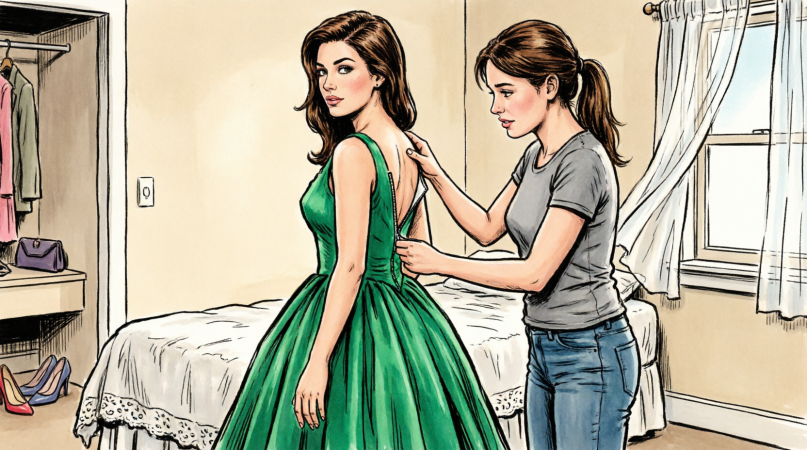
Inside, wrapped in tissue paper, was a dress so beautiful it made my chest tighten.
It was emerald green, deep and luminous, with clean lines and expensive structure.
The fabric had that unmistakable feel of high-end tailoring, smooth and cool and impossible to mistake for anything ordinary.
The neckline was elegant without trying too hard.
The waist was sculpted.
It looked like it belonged at a gala, not in the closet of a woman whose work wardrobe consisted mostly of blazers and pharmacy whites.
Then I saw the brand label.
Then the price tag.
I looked up at Nathan in disbelief.
“Where did you get this?”
He shrugged and poured himself water as if he had brought home takeout.
“Boutique downtown near the hotel.
I walked by, saw it, thought of you.”
That answer should have comforted me.
Instead, something inside me went still.
Nathan did not walk by boutiques and think of me.
Nathan compared gas prices across apps.
Nathan once spent fifteen minutes arguing with a cashier over a coupon worth four dollars.
Still, I ran my fingertips over the fabric and felt my defenses weaken.
It had been a brutal year.
Since my mother died, I had taken over the three neighborhood pharmacies she had spent her life building.
I loved the business, but it had swallowed whole sections of me.
My days were inventories, licensing renewals, staffing gaps, patient complaints, insurance claims, and the constant pressure of keeping small independent stores alive in a world designed to crush them.
I had not bought anything pretty for myself in a very long time.
“It’s beautiful,” I said quietly.
Nathan smiled, and for a split second he looked
pleased in a way that felt strangely detached from me.
“You deserve something nice.”
That night, over dinner, he talked about his conference in broad, boring strokes.
Meetings.
Hotel coffee.
Networking dinners.
Industry chatter about mergers and regional expansion.
I only half listened because my eyes kept drifting to a packet of papers on the dining table.
Nathan had left them there before his trip and reminded me about them again over dinner.
“Sign those before Monday,” he said.
“It’s just a routine authorization.
A consultant wants to review some numbers if we’re going to talk seriously about growth.
Nothing major.”
Normally I would have read every line.
I was careful by nature, especially with business documents.
But I was tired, and Nathan knew it.
“I’ll get to it tomorrow,” I said.
He nodded, satisfied.
I should have known then that his satisfaction had nothing to do with the dress.
Saturday morning, Nathan left after breakfast, saying he had to finish a report at the office.
He kissed my forehead, told me not to spend the whole day working, and walked out with his laptop bag.
By early afternoon, the apartment was quiet.
I was at the dining table in old sweatpants, a mug of reheated coffee beside me, trying to clear a stack of paperwork.
The dress box sat on the sofa across from me like a bright, impossible jewel dropped into my ordinary weekend.
Then someone knocked.
It was Emily, Nathan’s younger sister.
She stood in the doorway holding a bakery bag and grinning apologetically.
“I was nearby,” she said.
“And I brought sugar as a bribe for showing up unannounced.”
Emily had always been easier to love than Nathan.
She was honest where he was careful, warm where he was guarded.
In the early years of my marriage, when I was still trying to understand Nathan’s silences, Emily was the one who translated them, softened them, or rolled her eyes at them.
I let her in, and we settled in the living room with coffee and pastries.
We talked about work, family, the neighbor downstairs who treated the hallway like extra closet space.
For half an hour, it felt like a normal Saturday.
Then Emily noticed the white box.
“What is that?”
I laughed.
“You’re not going to believe me.
Nathan brought me a dress from his trip.”
Her eyes widened.
“Nathan bought you a dress? Voluntarily?”
“That was my reaction too.”
I opened the box and lifted it out.
Emily actually gasped.
The fabric caught the afternoon light and flashed like a gemstone.
“Claire, this is stunning,” she said.
She ran her fingers carefully along the sleeve and then looked at me with a sheepish smile.
“Can I try it on? Just for one second? I swear I won’t stretch anything.”
I laughed and nodded.
“Go ahead.”
She took it into the guest room.
A minute later, she stepped back out wearing the dress, and for a second we both just stared.
The fit was close enough to be uncanny.
The dress skimmed her frame as if it had been made with her body in mind.
Emily turned toward the full-length mirror by the window.
Her smile vanished.
At first I thought she had pricked herself on a pin.
Her hand flew to the back of
her neck, then slid inside the bodice.
Her face emptied of all color.
“Take it off,” she gasped.
“What?”
Now she was truly panicking, clawing at the zipper with one hand, staring at her reflection as if she had seen a ghost behind herself.
“Take it off me, Claire, right now.”
I was on my feet immediately.
I reached for the zipper and tugged it down while Emily fumbled inside the dress with shaking fingers.
When the zipper dropped, she pulled out a small cream card pinned flat against the inner seam.
“Read it,” she whispered.
The boutique logo was embossed on the front in gold.
I opened it.
Inside, in Nathan’s handwriting, were the words that split my life into before and after.
Vanessa — wear the emerald one tonight.
Once Claire signs Monday, there’ll be nothing left in our way.
N.
I read it twice.
Then a third time, as if repetition might force a different meaning out of the same sentence.
Emily pointed shakily to the inside neckline.
Tucked under the designer label was an alteration slip.
I slid it free.
Final fitting approved for Vanessa Mercer.
Deliver to Grand Regent Hotel, Suite 814.
Attention: Mr.
Nathan Cole.
My name was not Vanessa Mercer.
Neither were the measurements on the slip mine.
For one wild second, I tried to force the pieces into an innocent shape.
Maybe a store mix-up.
Maybe Nathan had bought the dress and they had pinned the wrong note inside.
Maybe there was an explanation still waiting somewhere just out of reach.
Then I remembered the packet on the dining table.
I ran to it, flipping pages so fast they nearly tore.
Near the bottom of the third page, under the consulting company name, was a name I had not properly registered the night before.
Vanessa Mercer.
Emily came up behind me, still holding the dress half off one shoulder, and read over my arm.
Her expression hardened from shock into horror.
“Claire,” she said, more steadily now, “this is not a routine authorization.”
She pointed to a paragraph dense with legal language.
I read it once and then again with my blood roaring in my ears.
It was a limited power of attorney.
If I signed it, Nathan would have temporary authority to negotiate on behalf of my pharmacies, provide financial access for review, discuss strategic restructuring, and represent the business in acquisition talks.
My knees almost gave out.
Emily swallowed hard.
“He texted me this morning asking if you’d mentioned signing papers yet.
Nathan never asks me things like that.
That’s why I came over.
It felt off.”
I looked at her phone.
There it was.
Did Claire sign the packet yet?
Nothing else.
No normal conversation.
No context.
Just the question.
My first instinct was to collapse.
My second was stronger.
I called Patricia Sloan, the attorney who had handled my mother’s estate and later helped transfer the pharmacies into my name.
She answered on the second ring.
I told her everything in a rush.
The dress.
The note.
The signature packet.
The consultant name.
“Take clear photos of every page and send them now,” she said.
“Do not sign anything.
And do not confront your husband until we lock down what he can access.”
Within ten minutes, Patricia called………………………………………….