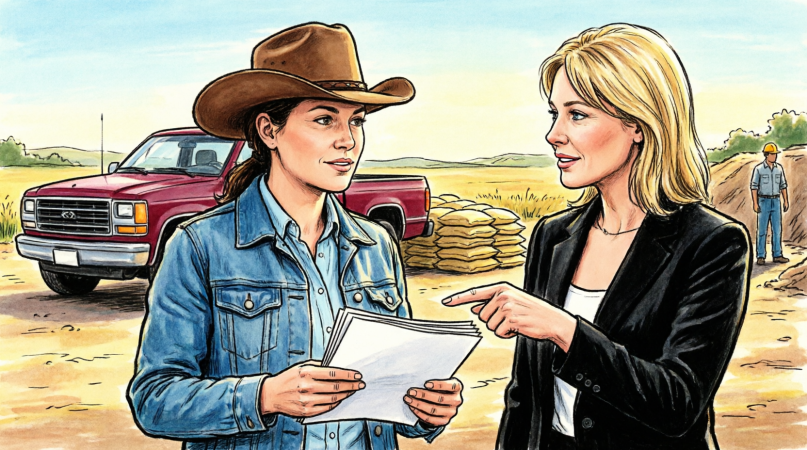
The first time Lisa Hawthorne called my ranch hers, she was wearing cream-colored linen and standing ankle-deep in feed store gravel that had absolutely no respect for cream-colored linen.
It was a Tuesday morning in late June, one of those brutal Texas mornings when the heat starts building before breakfast and by nine o’clock the sun already feels personal. I had pulled my truck up to the loading zone outside Murphy Feed & Supply, backed in close to the pallet stack the way I always did, and was muscling fifty-pound grain bags into the bed one by one because there are some tasks you don’t outsource if you want them done right. My T-shirt was stuck to the small of my back. Dust clung to my jeans. I had a smear of grease on my wrist from tightening a loose trailer latch before I left the ranch, and my hair was twisted into a knot that had given up pretending it would survive the morning neatly.
Tom Murphy had just yelled from inside that he’d knocked ten dollars off the mineral blocks because the supplier had overbilled him and he was “sharing the blessing” when a shadow fell across the side of my truck.
I straightened up with a bag balanced against my hip and found Lisa standing there smiling like a woman in a jewelry ad.
Not happy.
Triumphant.
She had papers in one hand and sunglasses pushed up into hair that had likely taken forty minutes and someone else’s labor to look that careless. Her manicure was pale pink. Her shoes had heels narrow enough to sink into the gravel every few seconds, but she carried herself like the ground had been informed in advance not to embarrass her.
“Just wanted to thank you for the ranch,” she said.
Her voice was pitched high and bright on purpose, and I knew instantly what she was doing. The parking lot wasn’t empty. Two ranchers were loading fencing supplies into a flatbed near the road. A woman with a toddler on her hip was carrying dog food to a minivan. Tom was half visible in the doorway, invoice book in hand. Lisa wanted witnesses. She wanted public possession. She wanted the story to begin here because public beginnings are harder to undo.
I shifted the grain bag into the truck bed and turned back to her.
“What ranch is that?”
She laughed as though I were adorable.
“Yours. Or I guess mine now.” She lifted the papers and fluttered them once like a flag. “Five dollars was more than generous, honestly. Samuel was right—you’d eventually come around.”
At the mention of his name, I looked past her.
He was sitting in the passenger seat of her Mercedes with the tinted window rolled halfway down, pretending to be interested in something on his phone. My husband. Eighteen years and a wedding ring and a daughter and four hundred thousand dollars of my money later, and he still could not bring himself to stand in front of me when he was doing something ugly.
If you had asked me, even then, what hurt most, I would have said not the theft.
The cowardice.
I reached for another feed bag.
Lisa stepped closer.
“You should probably start clearing out the house by Friday,” she said. “I’m meeting a contractor there Monday and I’ll need the place emptied enough to get measurements. Samuel says the old stables are perfect for what I have in mind. Yoga, events, maybe a small wellness retreat. Obviously all the horse stuff has to go, but the bones are good.”
The horse stuff.
That’s what she called thirty years of bloodline building, rehab work, breeding records, tack rooms, foaling stalls, and the only place in the world that had ever felt like my own spine.
Tom Murphy came out from the store then, wiping his hands on a rag. Tom had sold me my first feed bucket when I was twenty-five and too young for the kind of grief I was carrying. He’d watched me load every bag and build every fence and pray over every late foal season on that ranch. He looked from Lisa to me to the papers in her hand, and something in his face changed from ordinary curiosity to pure disgust in the time it took him to take three steps forward.
“Everything all right, Lily?”
I set another bag down.
“Just fine, Tom.”
Lisa shoved the papers toward him with the sort of confidence that belongs almost exclusively to people who have never had consequences arrive on time.
“Not a problem at all,” she said. “Lily’s just adjusting to the new ownership arrangement. We closed the transfer yesterday.”
Tom didn’t take the papers. He looked at me.
Then, finally, at the signature block visible near the bottom.
I saw his eyes narrow.
That mattered.
Because Tom knew my signature. He’d seen it on checks, delivery receipts, feed contracts, veterinary authorizations, invoices, and one terrible county tax appeal letter I signed in a rage seven years earlier after a bureaucrat misclassified half my acreage as improved luxury property because someone saw the renovated barn and got ideas. My handwriting has a slant and a certain bluntness to it. The signature on Lisa’s document looked like someone had forged a woman’s name using memory and contempt.
But Tom was smart enough not to say that in the parking lot.
He only said, “That so.”
Lisa smiled wider, misunderstanding everything.
“You’ll update the delivery records, right? Going forward all feed invoices go through me.”
Tom looked at her shoes. Then at her car. Then at Samuel in the passenger seat. Then back to me.
“I’ll wait until I hear that from the owner,” he said.
There are few sounds as satisfying as a vain person realizing a room has not arranged itself to support her after all. The smile on Lisa’s face did not disappear, exactly. It curdled.
She turned toward the Mercedes, tapped something on her phone, and a second later my own started buzzing in my back pocket.
Samuel.
Of course.
I ignored it.
The phone stopped, then buzzed again.
Then Lisa held her own phone toward me with a tiny, poisonous smile.
“Samuel wants to talk.”
I set both hands on the truck bed and closed the tailgate slowly.
It latched with a hard metal thunk.
Then I walked to the cab, opened the door, and climbed in without taking the phone.
In the mirror I watched Tom take the papers at last. Watched him read just enough to understand the audacity. Watched him look up at Samuel in the car and fail, absolutely fail, to hide what he thought.
It was a good beginning.
The drive from town back to the ranch takes twelve minutes if you know the road and nobody in front of you is dragging a hay trailer with one bad wheel. I know every turn, every dip, every stretch where the live oaks lean close enough over the county road to throw dappled light across the hood in the mornings and where, after a hard rain, the ditch floods first on the east side. I know exactly where the Henderson fence gives way to old stone wall, where the road bends past the dry creek bed, where the shoulder narrows and deer step out dumb and sudden at dusk.
I drove that route in silence with both hands on the wheel and a pressure behind my eyes that felt less like panic than precision.
Shock is useful if you don’t let it become drama.
By the time the truck crested the low hill that opened up onto Brennan Ranch, I was breathing normally again.
The place looked the same as it always had from a distance.
The long sweep of pasture broken by cedar and mesquite. The main house sitting low and white against the rise. The red roof of the main barn visible beyond it. The north fence line catching the sun. The stock tank flashing dull blue in the heat. If you stood at the gate and didn’t know anything else, you would think the world remained completely intact.
Then I saw the rental truck.
Parked beside the equipment shed.
Back doors open.
And Elena’s truck pulled up near the barn, angled sharply like she had arrived in a hurry and chosen position over prettiness.
I killed the engine and sat still for one beat.
Elena came out of the barn before I reached the porch.
She had a clipboard in one hand and her reading glasses on top of her head, which usually meant annoyance strong enough that seeing properly had become a secondary priority. Elena Ramirez had managed my ranch for twelve years and had the exact kind of face that made weak men either avoid her or underestimate her, depending on how badly they needed to feel superior. Forty-nine. Compact, hard-muscled, hair always in a braid or cap. She could sort a colicky foal, fix a hydraulic gate, and tell from ten yards if a man was lying to her.
She looked at my face once and said, “What did that woman say to you?”
“That she bought the ranch for five dollars.”
Elena didn’t blink.
“That explains Samuel loading his things into a rental truck at seven this morning.”
I stopped.
“He what?”
“He’s been in and out of the house all day. Started before sunrise. I asked him if you knew. He said yes. Sounded smug enough that I believed him for about three seconds.” She tilted her head. “Then I saw Lisa’s car at the gate and figured whatever was happening wasn’t anything decent.”
I looked toward the open truck doors.
A lamp I had inherited from my mother was standing inside beside a row of storage bins. My old copper stock pot from the kitchen. A stack of framed photographs. Things from my house, my life, being packed by a man who thought my consent was optional.
I should tell you now that my name is Lily Brennan. I was twenty-five when I bought that land with the two hundred thousand dollars my father’s life insurance paid out after the tractor rollover that killed him. I’m forty-five now. Which means I had already spent twenty years building that ranch before my husband decided his affair deserved my acreage as a housewarming gift.
Twenty years is enough time to become the shape of a place.
It is enough time to know every mare’s labor pattern and every section of fence that goes first in an ice storm and which field drains worst after heavy spring rain. It is enough time to pull cactus by hand, reseed pastures, negotiate feed prices through drought, build a breeding program from scratch, and watch the whole county go from calling your land worthless scrub to envying the valuation once growth and patience finally prove them wrong.
The land had not come to me through old money or ease. It came with my father’s death and a check people told me to invest “safely.” Bankers suggested bonds. My mother suggested a duplex near San Antonio. My aunt said, with the pity people reserve for women they think are making their last irreversible mistake, “Lily, honey, land like that just eats money.”
Maybe it does if you don’t understand animals or weather or time.
But I did.
I bought two thousand three hundred acres of hard Hill Country ground and a half-collapsed house everyone said would bleed me dry. The first year I lived in one usable room with a camp stove and a mattress on the floor while I patched the roof and learned where the pipes burst in frost. The first foaling season I slept in the barn with a shotgun and a halter rope because coyotes were bold and I didn’t trust the old gates. I mended fence with bleeding hands. I bought one mare when I could only really afford half of one. I bartered labor for hay. I learned how to stretch feed, how to walk a field and know whether it needed rest or grit, how to build slowly enough that every improvement actually held.
The stables Lisa called perfect for yoga had once had no doors and a roof line bent low enough to leak in three places every storm.
The bloodlines she called horse stuff had taken me fifteen years to develop.
The stock tank she said would make a lovely reflection pool for weddings had once been mud and rusted pipe until I dug it out with my own shovel and a rented backhoe I could barely steer.
That ranch was not property in the abstract.
It was the only long thing I had ever made with my own hands.
And now Samuel had packed my copper pot into a rental truck.
We went into the house together, Elena and I.
The front door was unlocked.
Inside, the air smelled faintly of cardboard, dust, and that stale after-scent rooms get when someone has been opening drawers they had no business touching. Cabinet doors stood open in the kitchen. The hallway closet yawned empty. In the bedroom, Samuel’s side of the dresser was cleared out. So were several shelves in the office. The file cabinet had been pulled from the wall and rummaged through hard enough that the top drawer no longer slid properly.
But my important papers were not there.
I had learned from living in Texas and from being a woman married to a man who increasingly mistook access for authority that the documents which matter most should never sit in the first place someone arrogant would look.
I went to the kitchen, dropped to one knee, and reached behind the old cream refrigerator to the gap between the wall and the compressor housing. My hand closed around cold plastic and metal. I pulled out the coffee tin.
It had once held Hill Country blend beans. Now it held my real life.
Inside, wrapped in a freezer bag, were the original deed in my name alone. The wire transfer records from the life insurance payout. The first purchase agreement. Insurance riders. Breeding records for the ranch’s foundation mares. And, folded in half beneath the file tabs, a hotel receipt I had found in Samuel’s jacket pocket three weeks earlier and never confronted him about because by then I was no longer dealing in suspicion. I was dealing in timing.
Riverside Hotel. Champagne. Room service for two.
And on the back, in looping handwriting I did not need graphology to identify:
Can’t wait for our new beginning. —L
Elena looked over my shoulder, then at the paper, then at me.
“You knew.”
“I suspected.” I folded the receipt carefully. “That’s different.”
I had suspected for almost a year, if I’m honest. Not because I am psychic. Because affairs, like bad fences, make noises before they collapse. Samuel had started staying in town longer after supply runs. He took more care with his hair when he said he was going to the feed cooperative. He became protective of his phone while simultaneously less interested in any real conversation with me. He was affectionate at odd times, absent at others, and increasingly contemptuous when I asked practical questions about ranch finances he had insisted on handling because “you’ve got enough on your plate.”
When women like me say we didn’t know, what we often mean is: I had evidence building quietly in my body long before I granted it legal standing in my mind.
My phone rang in my hand.
Margaret.
Samuel’s sister.
If there was one person in his family who had remained tethered to reality, it was Margaret. Older by three years, divorced young, owner of a hardware store in Boerne, and completely uninterested in protecting male nonsense once it crossed into public stupidity. She and I had never been close, but we understood each other. We both knew exactly how much family damage could be accomplished by charming men with weak spines and stronger appetites.
I answered on the first ring.
“Tell me you’re sitting down,” she said.
“I’m standing in my ransacked kitchen holding proof my husband is an idiot. So, close enough.”
She exhaled.
“I’ve been trying to reach you since yesterday. He came by my store last week asking weird questions about deeds and county transfers. Then he wanted to know how postnups hold up if one spouse signs under alcohol. Then he asked if old family property can be reclassified if the marriage is long enough. Lily, whatever he’s doing, it’s bigger than an affair.”
I leaned against the counter.
“He filed a forged deed transfer. Sold my ranch to Lisa Hawthorne for five dollars.”
Margaret went silent.
Then: “Jesus Christ.”
“That was more or less my reaction.”
“You need Marcus Fitzgerald. Immediately.”
I almost laughed because that was exactly where my mind had already gone.
Marcus Fitzgerald had handled my father’s estate twenty years earlier and, later, a series of legal matters connected to the ranch—easements, livestock insurance disputes, water rights, a neighboring landowner who kept trying to move his fence five feet every few years as if I wouldn’t notice. He was expensive, sharp, and had the irritating habit of being right before anyone else was ready for it.
“Already on the list,” I said.
“Good. And Lily?”
“Yes?”
“If Sam thinks he can bluff you out of your own life, make sure the first thing he learns is that he married the wrong kind of woman for that.”
After she hung up, Elena was still standing by the kitchen table watching me with those dark, steady eyes that made evasion impossible.
“What do we do first?”
I looked around at the open drawers, the stripped closet, the emptiness where he had tried to make absence feel inevitable.
“We lock down the horses,” I said. “Then we call Marcus. Then we make copies of everything. And after that?”
I held up the forged papers Lisa had waved in the feed store parking lot.
“We teach my husband the difference between possession and ownership.”
That first night after the feed store confrontation, I barely slept. Not because I was afraid. Because every time I closed my eyes I saw small things. Samuel lifting my mother’s pot into the truck. Lisa’s manicured hand on the forged deed. My father’s old leather chair still in the study, one of the few things I had kept unchanged in the house because it felt like the only honest piece of furniture in it. Anger did not come in a clean line. It came in layers, and beneath it all was grief—not for Samuel, not really, but for the version of my life I had still been nursing somewhere in me, the one where my marriage had been strained but salvageable, where disrespect had not yet become criminal, where this house still held memory without contamination.
I met Marcus the next afternoon in his office on the square in Fredericksburg, where the courthouse dome shows up in every postcard and nobody can keep a secret longer than a tractor takes to cross Main Street. His waiting room had the same dark leather chairs and framed land plats I remembered from my father’s probate case. Even the receptionist was the same woman, older now but still wearing lipstick sharp enough to slice through lies.
Marcus came out himself when he heard my name.
He had more silver in his hair now and less patience in his face, which on him was an improvement. He shook Elena’s hand, nodded at the banker’s box of documents we had brought, and said, “I’d ask how you’re holding up, Lily, but I’d rather start with the good news.”
“There’s good news?”
He smiled without kindness.
“Your husband is stupider than I hoped.”
He spread the documents across his desk with a surgeon’s calm. The original deed. The forged one. The bank statements. The hotel receipt. The copies Elena had made of Samuel’s ranch account logs before he could destroy them. Marcus studied everything in silence for nearly twenty minutes, only occasionally making a small note in the margin or humming under his breath when something particularly damning appeared.
Finally he looked up.
“The ranch is separate property,” he said. “Always was. Your father’s life insurance funded the purchase before the marriage. The deed has only ever been in your name. There’s no legal theory under Texas law that gives Samuel ownership here absent a valid transfer or some sort of structured community property conversion. Which, thankfully, he does not have.”
“He thinks he does.”
Marcus’s eyes narrowed.
“The derby party?”
I nodded.
A year earlier, when Samuel’s money habits had started smelling wrong and his requests to “streamline our legal documents” had become more frequent, I had gone to Marcus quietly. I told him I thought my husband was preparing something—not necessarily a theft yet, but a consolidation. The kind of small marital creep by which a woman’s separate life becomes a family asset only when the family is him.
Marcus had drafted a postnuptial agreement that reaffirmed exactly what the original deed and purchase records already proved: Brennan Ranch, its improvements, all breeding stock directly tied to my pre-marital investment, and all associated intellectual property remained mine alone. If Samuel ever attempted to claim otherwise, the agreement also required him to surrender any claim to spousal support and acknowledged that any attempt to transfer or encumber the ranch without my notarized, witnessed consent constituted fraud.
The problem was getting Samuel to sign it without triggering suspicion.
Samuel solved that part himself.
At the Hill Country Derby Party the previous spring—an event of hats, bourbon, too much money, and performative hospitality—he had appeared beside me around sunset with a folder and one of those too-charming smiles he used when he thought he was managing me.
“Sign these before you get too deep into the mint juleps,” he’d said. “Tax strategy and operating authority. Marcus said we need them done before the quarter closes.”
He was already drinking. The folder cover page bore Marcus’s letterhead because Marcus and I had arranged exactly that possibility. Samuel flipped impatiently to the signature lines without reading. I did too. We both signed.
He thought he had tricked me into giving him access.
What he actually did was sign away his fantasy of ever touching the ranch.
Marcus leaned back now and steepled his fingers.
“The funniest part,” he said, “is that if he used the signature page from those documents to create this forged deed, he just proved knowledge and intent simultaneously. Which means your husband, if he’s as lucky as he’s been stupid, is facing civil fraud instead of prison-level stupidity. But that depends on what else we find.”
He slid the forged deed back toward me.
“This won’t hold up. Not for a minute. But that’s not the real danger.”
“What is?”
“The narrative,” he said. “Possession creates confusion. Confusion creates time. Time lets liars move assets, sell stock, poison your daughter, and convince town gossips that you’re unstable enough to deserve what’s happening.”
He was right.
In a county like ours, the law matters, but so does the story people choose to believe while waiting for the paperwork to catch up.
We filed for an emergency injunction before lunch.
By the time we were done, Marcus had a petition ready to freeze any attempted transfer, bar Samuel and Lisa from entering or altering the property, and force the county clerk to flag the deed as disputed pending forensic review. He also drafted a criminal complaint for forgery and financial fraud, though he advised waiting until we’d fully mapped the stolen money.
“Once we press criminally,” he said, “nobody gets to walk this back quietly.”
“Good,” I said.
He watched me for a second.
“Sometimes people say that before they’ve understood what criminal really means.”
“I understand. I’m not trying to scare him. I’m trying to stop him.”
 :
: