By the time I drove through the front gate of the Mitchell ranch with a degree from Texas Tech riding shotgun and four years of hopes packed into the cab of my beat-up Chevy, I had already rehearsed the homecoming a dozen different ways.
In every version, my mother met me on the porch with flour on her hands and tears in her eyes. My father stood behind her, trying to look stern and failing because pride kept pulling at the corners of his mouth. My brother Blake came in from the north pasture, pretending not to be impressed until he saw the rolled-up plans in my hand and realized I hadn’t come home just to be his little brother again. I had come back with ideas. With solutions. With something useful enough to matter.
That was the version I kept alive all the way from Lubbock to our patch of West Texas, mile after dusty mile, while the horizon shimmered in the heat and the radio faded in and out between country songs and weather warnings. I pictured my mother’s apple pie cooling on the windowsill. I pictured my father thumping me once on the shoulder and saying, in that flat, unsentimental way of his, that a degree was fine, but it meant something more that I’d brought it back home. I pictured Blake rolling his eyes and calling me college boy, but laughing when he did it, the way he had when we were younger and being teased still meant being loved.
I should have known better. Families don’t change just because you leave long enough to start imagining they will.
The driveway looked exactly the same as it had when I was a kid. Two long ruts in hard-packed dirt, bordered by mesquite and yellow grass that seemed permanently one dry season away from turning to dust. I used to race my bike up and down that drive, legs pumping, pretending the ranch was a kingdom and I was coming back from some heroic errand only I could complete. The irony of remembering that while pulling in at twenty-four with an agricultural degree and the stupid hope of finally being taken seriously was not lost on me, even then.
The first person I saw was Blake.
He was up on the John Deere like it had been built around him, one boot hooked on the step, baseball cap backward, sunburn across his neck, a hand lifted against the glare as he watched me roll in. He had that posture he always got when he felt he was defending ground that belonged to him. Blake was six years older than me, broad in the shoulders, quiet when it suited him, loud when it benefited him, and so deeply stitched into the daily life of that ranch that sometimes I thought my father couldn’t tell where the place ended and Blake began.
Mom came out next, drying her hands on the apron she wore so often it felt like part of her skin. She hurried down the porch steps and hugged me before I had both boots on the ground. The hug was real. My mother loved me in all the complicated, insufficient, undeniable ways she knew how. She held on too tight, kissed my cheek, said, “You’re too thin,” and then stepped back to look at me with eyes that already carried something I didn’t want to name.
Pity, maybe.
Worry.
Or the knowledge that she understood something I didn’t yet.
Dad came out last.
He didn’t hug. He never hugged unless somebody was dead or bleeding. He extended one rough hand and gripped mine hard enough to make it clear affection, when it came from him, would always have conditions attached.
“Welcome home, college boy,” he said.
There are nicknames and then there are labels sharpened into tools.
I smiled anyway. “Good to be back.”
Blake climbed down from the tractor and sauntered over, taking his time, surveying me with the expression of a man inspecting used equipment he wasn’t sure he wanted to buy.
“He actually did it,” he said. “They let him graduate.”
I laughed because that seemed like the right response. Even then I was still trying to find the mood I had pictured on the drive back.
That first night, my mother cooked like she was trying to protect me from something with butter and gravy.
There was chicken-fried steak, mashed potatoes, green beans cooked to death the way my father liked them, cornbread, sweet tea, and a pie waiting on the counter for later. The four of us sat in the kitchen under the old brass light fixture, and for the first few minutes things almost felt normal. Mom asked about professors she didn’t know. Dad asked one practical question about whether the degree had cost more than it was worth. Blake told some story about a calf getting stuck in a fence line and made himself laugh harder than the story deserved.
I waited for the right opening.
Then I took it.
I started talking about what I had spent the past four years learning. About soil conservation, about crop rotation, about how the state’s water problem wasn’t going to solve itself. About drought-resistant forage. About the possibility of installing more efficient irrigation systems in the orchard and around the cattle tanks. About grant programs that could help offset costs. About new agricultural models that could keep old ranches alive without selling their souls to developers or drifting toward bankruptcy one bad season at a time.
I had notes in my truck. Diagrams. Budget estimates. I had spent my last semester building a sample modernization plan around our ranch, because I was that sure I’d be welcomed back into it.
Dad listened the way he listened to weather reports he didn’t trust.
Blake didn’t even try to hide the smirk spreading across his face.
When I mentioned drip irrigation and water savings, he snorted into his tea.
“Drip irrigation in West Texas?” he said. “What’s next, Ethan? You gonna get us a little Instagram account and start selling artisanal beef to people in Austin?”
Mom shot him a look. “Blake.”
But he was just getting started.
“Maybe throw in a lavender field. Get some alpacas. Make the place real fancy.”
I looked at Dad, waiting for him to do what I had wanted him to do my whole life—take my side in a room with Blake.
Instead he pushed his potatoes around with his fork and said, “While you’ve been reading books, your brother’s been here doing the work.”
I still remember the way the kitchen sounded after that. The hum of the refrigerator. The clink of Mom setting down her glass too carefully. A dog barking somewhere outside.
I said, “I was studying so I could help us adapt.”
And Dad looked at me the way men like him look at any sentence that arrives wrapped in the language of change.
“This land ain’t changing hands,” he said. “Blake’s been running things with me. He knows every fence, every pipe, every cow, every acre. He earned that.”
Earned.
That word sat there between us like something dirty.
Mom reached across the table and put her fingertips on my wrist. “We love you, honey. But you can’t split a ranch in two.”
I can’t explain what that felt like unless you’ve ever spent years preparing for a future only to learn the people you prepared for never imagined you inside it.
I had come home thinking I was returning to my place.
Turns out the place had been filled while I was gone.
Blake was the one who stayed. Blake was the one who knew the ranch as it was, not as it could become. Blake was the one who had my father’s approval because he never asked for more than the shape of the life my father already understood.
That night I sat in the barn long after everyone went to bed, perched on an overturned bucket with the smell of hay and leather all around me, and called the only person I knew who might understand the size of the crack I felt running through my chest.
Grandpa Henry picked up on the second ring.
“What’s wrong, boy? You sound like you found a rattler in your boot.”
I laughed once, because that was Grandpa. Even worry came at you sideways.
I told him everything. About the dinner. About Dad saying Blake had earned the ranch. About the way Mom kept asking me to be reasonable, as if fairness were just another unrealistic luxury you let go of when family demanded it.
Grandpa listened without interrupting.
When I finished, he let out a low whistle.
“Well,” he said, “sounds like they threw you a homecoming parade with pitchforks instead of pie.”
That made me laugh harder than I wanted to, and once I started, I nearly couldn’t stop.
That was Grandpa’s gift. He never made pain smaller, but he somehow made you feel bigger than it.
“Come out tomorrow,” he said. “I got beer, shade, and better conversation than anything happening over there.”
So I drove to his place the next day.
Grandpa’s property sat two hours west of ours, smaller and quieter, with rows of pecan trees that looked old enough to have opinions. He had sold off most of his land after Grandma died, keeping only the house, a few outbuildings, and the grove he loved too much to part with. At eighty-four, he was still lean and wiry, with a face carved by sun and stubbornness. He lived alone, cooked badly, swore at the television during football games, and knew more about the land than anyone I’d ever met.
He was waiting for me on his porch swing with two beers already open.
As a kid I used to love visiting him because he treated me like a person instead of an unfinished version of somebody else’s expectations. We’d walk the trees together, and he’d point at the bark, the soil, the way water pooled after rain, and tell me things as if he were letting me in on secrets the world only shared with people paying close enough attention.
“The sun is the engine of the world, boy,” he would say, pointing up through the pecan branches.
When I was ten, I thought it was just one of those old-man sayings that sounded profound because he said it slowly. Years later, I realized he meant every word.
We sat on the porch that day until the light turned golden, and I told him the whole story again. About the degree. About the plans. About coming home only to discover that everyone had already decided what role I was allowed to play.
He listened, then took a slow swallow of beer and said, “Your mama can bake a fine pie, but she sure can’t bake justice.”
I snorted beer through my nose laughing.
“That’s awful.”
“It’s accurate,” he said.
Then, after a while, he told me something I had never heard before.
“When I was your age, I wanted to be a geologist.”
I turned toward him. “You?”
He shrugged. “Had a knack for rocks. Could walk a dry creek bed for six hours and be happier than a pig in shade. Your great-granddaddy thought geology was one rung above witchcraft and two below laziness. Said if I wanted to spend my days staring at dirt, I could do it for free on the ranch.”
“You never told me that.”
“What was I gonna do?” He smiled faintly. “Show up to my own life every day and mope about all the versions of me that didn’t happen?”
I said nothing.
He tipped the bottle toward the yard.
“Life has its own plan sometimes. Doesn’t mean your dreams are useless. I still collected rocks. Still got a whole shed full of ‘em. Life’s too short not to keep some piece of what lit you up.”
That became our pattern over the next three months.
My family ranch became a place I slept, ate, and tried not to resent. Grandpa’s place was where I breathed.
The job market was tight. Every consulting position I applied for seemed to already have three people lined up ahead of me with connections, experience, or both. I took shifts at the feed store in town because pride doesn’t buy gas and student loans don’t care whether your future has just been rearranged without your permission. Every morning I’d watch Dad and Blake head out before sunrise, talking over the ranch business I was no longer invited into, and every evening I’d come home to conversations that somehow managed to close like trapdoors whenever I entered the room.
The feed store paid almost nothing.
I stocked mineral blocks, hauled sacks of chicken feed, and answered questions from people who looked at my degree the way some folks look at yoga—interesting in theory, suspicious in practice.
The only part of the week I looked forward to was driving out to Grandpa’s on Saturdays.
Sometimes we talked agriculture. Sometimes football. Sometimes nothing useful at all. He’d show me a geode the size of a cantaloupe and tell me where he found it in 1962 like it was the greatest adventure of his life. Other times he would just sit on the porch with me and let the silence be what it was.
One evening he held up a quartz-veined stone toward the sunset and said, “Most folks only look at land and ask, what can I take from it? Wrong question.”
“What’s the right one?”
He smiled, but didn’t answer right away.
“What can it become?”
I didn’t know then how hard those words would come back for me later.
Then Grandpa died.
No warning, no hospital vigil, no long goodbye. Mom called on a Tuesday morning while I was unloading feed and said he had gone in his sleep, peaceful, just like that.
Some people get cheated by death because they’re not ready. Grandpa would’ve hated that sentence. He’d probably have said death didn’t cheat anybody, it just kept terrible scheduling habits.
The funeral was small.
Family, a few neighbors, a preacher who mispronounced two names and still somehow managed to get the spirit of him right. I stood in my only suit under that huge West Texas sky while they lowered him into the ground, and all I could think was that the one person in the family who had always looked at me and seen possibility was gone.
On the drive back to the ranch, no one said much.
That night Mom told us the lawyer had scheduled the will reading for the next morning.
Blake made some crack about Grandpa probably leaving me his rock collection, and even then I noticed something in his face beneath the smirk. Not fear exactly. Curiosity sharpened by entitlement.
I barely slept.
At dawn I stood in my childhood bedroom watching the horizon turn from black to purple to fire, and I kept hearing Grandpa’s voice.
The sun is the engine of the world, boy. Don’t you forget it.
The lawyer’s office sat over the hardware store in town in one of those old brick buildings that felt permanently dust-coated no matter how often anyone cleaned it. Mr. Wilson wore thick glasses and a tie too tight around the neck. He had the expression of a man who spent his life reducing emotion to paperwork and felt rather noble about it.
Dad sat straight-backed and grim. Mom looked wrung out already. Blake leaned back with one leg crossed over the other as if he were there to collect what the universe had always meant to hand him.
Wilson read the will in that dry legal voice that made every sentence sound both official and faintly insulting.
To my son James Mitchell and his wife Ellen, I leave my home and fifteen acres of pecan-producing land…
That part made sense.
To my grandson Blake Mitchell, I leave my 1969 Ford pickup and my collection of vintage farming equipment…
Blake grinned.
Then Wilson cleared his throat.
“To my grandson Ethan Mitchell…”
The room changed.
I sat up without meaning to.
“I leave my collection of geological specimens, all contents of the storage shed behind my house, my grandfather’s pocket watch, and twenty-five acres of land located at the following coordinates…”
He read out the legal description.
I had no idea where the coordinates pointed.
Dad did.
His whole face tightened.
“That worthless stretch?” he said.
Wilson consulted a map and nodded. “The parcel Mr. Mitchell purchased in 1972.”
I knew the story in fragments. Grandpa had once bought a tract of dry land out west so barren people treated it like a punchline. Supposedly he got it dirt cheap from a rancher desperate to unload it. Everyone laughed. Grandpa laughed too, which I think made them trust the joke more than they should have.
Blake barked out a laugh right there in the lawyer’s office.
“Well,” he said, “looks like Grandpa really did leave you a VIP seat in hell. That land’s so worthless even the vultures bring their own lunch.”
Mom patted my hand.
“I’m sure he meant well, honey.”
Dad shook his head as if Grandpa had managed one final act of eccentric nonsense from beyond the grave.
Wilson handed me a key.
“Your grandfather mentioned there’s a trailer on the property. Habitable condition.”
Blake snorted. “Habitable for lizards, maybe.”
That should have been the moment I saw it the way they all did: dirt, rocks, a joke inheritance from a man everyone had always half-loved and half-dismissed for his strange side obsessions.
Instead, weirdly, I felt something else.
Not hope. Not yet.
Just resistance.
On the drive back to the ranch, Dad cornered me in the kitchen while Mom pretended to be busy at the sink.
“Be smart about this,” he said. “Sell that useless plot. Add the money to the family operation. Blake knows what he’s doing here. You could learn from him.”
Learn from him.
The phrase closed around me like a trap.
I saw the rest of my life with sudden, painful clarity. Working under Blake. Watching him run what I had once imagined helping shape. Being tolerated, never trusted. Present, but peripheral.
Then Grandpa’s voice surfaced in my head so clearly it might as well have come from the next room.
Land is never just dirt, boy. It’s a promise.
I straightened.
“No,” I said.
Dad frowned. “No what?”
“I’m not selling.”
That went over about as well as a lit match in a hay barn.
Within minutes the kitchen was full of raised voices. Dad talking about family loyalty. Me talking about respect. Blake wandering in just in time to throw gasoline on it all by suggesting I might turn the place into a lizard sanctuary since that seemed more aligned with my future prospects.
Then Dad said the thing that broke whatever thin illusion of home I’d still been holding.
“If you’re too stubborn to see sense,” he snapped, “then get out and go live in your dirt hole.”
Silence fell so suddenly it felt violent.
Mom’s eyes widened. Even Blake looked caught off guard, though not enough to object.
I stood there with my heart pounding and realized something hard and clean: if I stayed, it would be on their terms forever.
“Fine,” I said. “I’ll go tonight.”
Mom followed me upstairs while I packed.
She stood in the doorway of my old room, watching me shove shirts and jeans into a duffel bag without folding any of them. Finally she disappeared and came back with a cardboard box.
“Your diploma,” she said quietly. “And some food. There’s cash in the envelope.”
She hesitated, then added with a sad little attempt at humor, “The lizards may appreciate your education more than your father does right now.”
That almost wrecked me.
But I took the box, loaded the truck, and drove away from the only home I had ever known with a degree, some clothes, a few casseroles in Tupperware, and a key to land everybody I loved had already laughed at.
The road to the property turned worse the farther I got from town.
The last five miles weren’t really road so much as permission to bounce violently in a mostly forward direction. Dust boiled behind the truck in thick red clouds. Mesquite thinned out. The sky widened until it felt absurd, like too much ceiling over a room with no furniture.
When my GPS finally told me I had arrived, I sat there with both hands on the wheel and stared.
Twenty-five acres of almost nothing.
Flat red-brown earth. Hard-packed, sun-battered, empty enough to make a person feel like an afterthought. A few stunted trees and patches of cactus. No real road. No water source that I could see. Nothing green enough to suggest mercy.
“My inheritance,” I said aloud. “Twenty-five acres of sun and dust. Grandpa must’ve thought I was part lizard.”
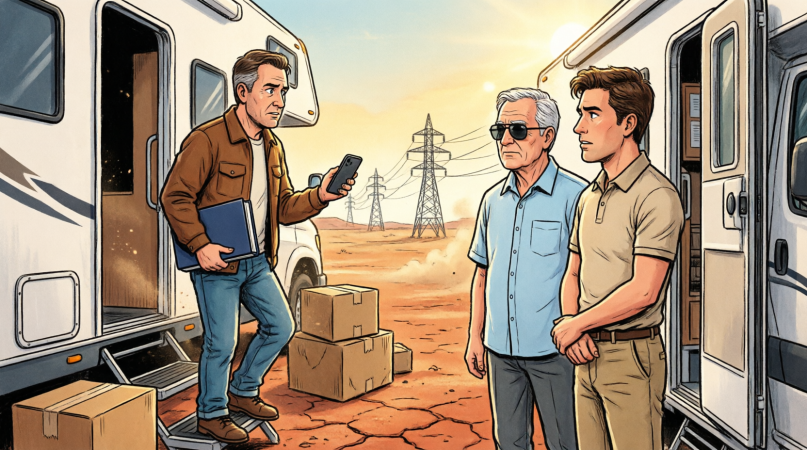
The trailer sat off to one side, silver once maybe, now faded into that particular dull metal color old mobile homes acquire after decades of weather and neglect. It leaned a little, like it didn’t fully trust the ground under it. The porch steps looked one hard stomp away from collapse.
Inside, though, was not what I expected.
The place smelled like old wood, tobacco, and heat. It was small, plain, and old, but clean. Somebody—Grandpa, probably—had made sure it was functional. There was a narrow bed, a worn couch, a tiny kitchen, a sagging chair, a bathroom that looked like it had been designed for a submarine, and on the table in the middle of the room sat a cassette player.
An actual cassette player.
A tape was already inside it, labeled in Grandpa’s shaky handwriting.
For Ethan.
I hit play.
The tape whirred once, and then his voice came through, scratchy and immediate enough to make my throat close.
“Ethan, if you’re listening to this, I’ve gone to join your grandma, and you’re probably standing in that trailer wondering whether I finally lost what little sense I had.”
I laughed once, and then had to sit down.
“Maybe I did,” he went on. “But I’ve watched you a long time, boy. You’re not afraid to look at things different. Your daddy and Blake, they only see what’s already there. Nothing wrong with that. Men like that keep the world running. But you—you look at a thing and wonder what it could be. That matters.”
I could hear the smile in his voice.
“Don’t be scared to look foolish. Fools change the world. The smart ones just maintain it. That land out there is waiting for somebody who can see its real value. I’m betting that’s you.”
The tape clicked off.
I sat there for a long time staring at the cassette player as if it might explain itself further.
Outside, the sun dropped lower and turned the whole empty place gold. The sky deepened from orange to purple to a blue so dark it almost rang. When the stars came out, they came hard and bright, unsoftened by city light or neighboring houses or anything else built by man.
I dragged a metal chair out onto the porch and sat there until cold started working its way into my boots.
Maybe grief had scrambled my brain.
Maybe I was romanticizing the last gift of a dead man because the living had made me feel too disposable to be objective.
But even then, on that first night, I couldn’t shake the sense that Grandpa had not been joking.
The next two weeks were lonely in a way I had not known loneliness could be.
Morning hit the trailer full in the face because there were barely any curtains. The sun became my alarm clock. I made instant coffee on the stove, sat on the porch steps, and tried not to think too hard about the fact that I had a degree, debt, and no real job prospects beyond the feed store shifts I was still clinging to in town. The trailer creaked in the heat. The wind carried dust into everything. At night, coyotes called in the distance and the silence between those sounds felt endless.
Mostly, I wandered.
At first it was boredom. Then habit. Then investigation.
I took soil samples. Measured slope. Noted shade patterns, sparse as they were. Set up a cheap weather station after buying one in Millerville, which proudly described itself on a welcome sign as home of the best pecan pie west of the Mississippi. By the end of the first week, I knew the daytime temperatures on that land ran brutal enough to fry an egg on a stone, and yes, on day nine I tested that theory.
It worked.
My failed corn experiment came next.
That was the agricultural degree in me refusing to accept humiliation without at least trying to grow something. I planted test rows in different spots, adjusted depth, hauled water by hand, muttered encouragement like an idiot, and watched every seedling die in spectacularly unimpressive fashion. The soil sucked up moisture and gave back contempt.
“The only thing growing out here is sweat,” I told a lizard who had taken to sunning itself on a nearby rock and watching my efforts with what looked suspiciously like judgment.
The lizard blinked slowly, which I chose to interpret as agreement.
Every night, I played another one of Grandpa’s tapes.
He had left dozens in a box in the trailer. Some were labeled with dates. Others had titles like Remember This, Seeing, For Hard Days, and simply, Future.
One night he said, “People see what they want to see, Ethan. Your daddy sees cattle land. Blake sees inheritance he can brag about. But value ain’t always obvious. Sometimes it’s hiding in plain sight like a diamond in the sun.”
A diamond in the sun.
I replayed that line so many times the tape began to wobble.
The breakthrough came from Tommy.
Tommy Martinez had been my roommate at Tech, a guy with a laugh like loose bolts in a toolbox and a talent for understanding practical opportunity faster than most people understood problems. He had taken a comfortable job in Houston with his uncle’s equipment dealership and thought my desert exile was the funniest tragedy he’d ever heard of.
“You still alive out there, hermit?” he asked when he called one evening. “Or have the lizards already elected you their mayor?”
“Still breathing,” I said. “Though I think one of them is disappointed.”
I filled him in on the land, the trailer, the dying corn, the tapes, the possibility that my grandfather had either left me a hidden opportunity or an extremely poetic insult.
Tommy listened, then went quiet for half a beat.
“You know,” he said slowly, “you might be sitting on a gold mine.”
I laughed. “Unless you mean actual gold under the dirt, I doubt it.”
“No, dummy. Sun.”
I went still.
“There are grants all over the place for rural renewable energy,” he said. “Solar farms. Wind too, but mostly solar where you are. My cousin just helped finance a project outside Austin on land people used to call useless. You’ve got no tree cover, high exposure, open acreage, and enough heat to cook breakfast on a rock. That’s not worthless. That’s solar country.”
I sat up so fast I nearly kicked over the chair.
The sun is the engine of the world, boy.
Grandpa’s voice hit me so hard I got gooseflesh in hundred-degree weather.
Over the next three days I practically lived at the Millerville library because the trailer’s internet worked only when it was in the mood and the weather felt charitable. Margaret, the librarian, took one look at the stack of printouts and grant websites open across the public computers and decided I was either on the edge of brilliance or complete collapse.
Possibly both.
The more I researched, the more the shape of it emerged.
Solar in Texas wasn’t a fantasy. It was booming. Federal programs, state incentives, rural development grants, tax credits, small-scale commercial generation. My twenty-five acres weren’t enough for a giant industrial site, but they were enough to matter. Enough to start. Enough to generate power, sell to the grid, and build from there.
I asked Tommy for numbers.
He whistled low when I described the scale I had in mind.
“Bare minimum for something worthwhile? A hundred grand,” he said. “Probably more. Unless you’ve got a rich uncle hidden somewhere.”
I looked out through the library window at the empty parking lot and said, “No rich uncles. Just one dead grandpa with a cassette collection and suspiciously good instincts.”
“Then you need grants, a bank, and a miracle.”
I ended up getting all three.
The grant application nearly killed me.
There were environmental impact assessments, financial models, projected output charts, site evaluations, grid connection plans, risk statements, community benefit language, and enough government jargon to make a sane man set his laptop on fire and go raise goats instead. I called old professors, begged favors from classmates better with spreadsheets than I was, and built the entire proposal from the floorboards up in that trailer while dust gathered in the corners and my diploma sat in the box Mom had packed like proof from another life.
When I finally hit submit at the library and got the confirmation email, Margaret leaned over the desk and said, “Important application?”
“Maybe the most important thing I’ve ever done.”
She smiled. “Then I’m rooting for you.”
The waiting was miserable.
Six to eight weeks, the site said.
In that time, I repaired the porch steps, fixed a leak in the trailer roof, kept taking measurements, kept listening to Grandpa’s tapes, kept trying not to let hope turn me into a fool.
Hope is dangerous when you have very little else. It doesn’t arrive as joy. It arrives as appetite. Suddenly everything in your life starts leaning toward a future that doesn’t exist yet, and every ordinary setback feels like a warning from the universe not to want too much.
Nearly seven weeks later, I was back at the library checking email when the notification came in.
Department of Energy.
Subject line: Rural Renewable Energy Initiative.
For a second I couldn’t breathe.
I downloaded the email and drove all the way back to the trailer before opening it because I didn’t want strangers around if the answer was no.
By then the sun was starting to sink, turning the whole property molten and strange. I sat on the porch with my laptop open on my knees and Grandpa’s empty chair beside me.
“Okay,” I said aloud, because talking to dead people had apparently become part of my personality now. “Let’s find out.”
I opened the email.
Then I read the sentence three times because my brain refused to trust itself.
We are pleased to inform you that your application… has been approved in the amount of $100,000.
I laughed.
Then I shouted.
Then I walked down off the porch and stood in the middle of my barren, laughed-at, sun-scorched inheritance with my arms hanging loose at my sides while the evening light drenched everything gold and thought, You knew. You old man, you knew.
The grant money wasn’t enough by itself. It made me credible, though, and sometimes credibility is the first currency that matters.
Once I had the federal award letter in hand, Desert First National in Millerville looked at me very differently. The bank manager, who had known my family since before I was born and had once pinched my ear for stealing peppermints from the candy bowl in his lobby, suddenly started speaking to me in the careful tone men reserve for people who might actually become important.
With the grant as leverage, I secured a loan.
Then another consultation.
Then an engineer.
Then deliveries.
The first trucks rumbled onto the land in a cloud of red dust carrying pallets of panels, mounting systems, inverters, cable, and equipment heavy enough to make my little patch of nowhere look like a construction site from another planet.
Three laid-off oil-field hands from town showed up asking if I needed labor. They were skeptical, amused, and deeply motivated by the promise of regular paychecks.
“You trying to be the next Elon Musk or something?” one of them asked around a wad of chewing tobacco.
“No,” I said. “I’m trying to make rent on a trailer and prove my dead grandfather wasn’t crazy.”
That got a laugh, and then we went to work.
I have never worked harder in my life.
We were up before sunrise. Digging trenches. Setting posts. Aligning panels. Running cable. Fighting wind, dust, heat, and the kind of exhaustion that strips every thought down to basic verbs. The agricultural degree people in my family had mocked turned out to matter plenty when I had to think about erosion patterns, soil stability, drainage, and how not to turn the whole site into a loose-dirt disaster the first time weather got ambitious.
My hands blistered and hardened. My neck stayed red no matter how much sunscreen I applied. I fell asleep most nights too tired to finish whatever I was eating.
And underneath all of it ran something I hadn’t felt since before coming home from college.
Purpose.
Clear, exhausting, life-ordering purpose.
When the utility engineer came to inspect the grid tie-in, he stood with his hard hat under one arm and shook his head slowly as he took in the rows of black panels angled toward the sky.
“Never thought I’d see anybody make old Henry Mitchell’s joke land worth something,” he said.
I smiled.
“He always said people were looking at it wrong.”
The day we brought the system online, I cried.
I don’t care how that sounds.
When the inverter display lit up and the first surge of solar-generated current fed into my own lines, then out toward the grid, I felt something in me unclench that had been locked tight since the day my father told me to get out and go live in my dirt hole.
I opened a beer at sunset and stood on the porch of Grandpa’s trailer looking over the first real phase of the farm.
“Cheers,” I said. “The engine’s running.”
The first check from the power company was just over three thousand dollars.
I framed it.
Not because of the money, though that mattered. Because it was proof. Proof that the land was not worthless. Proof that I had not been insane. Proof that I had taken a joke inheritance and turned it into current moving through real wires toward real homes.
By six months, I had doubled the panel count.
By a year, I had leveraged my first successful phase into additional grants and financing.
The operation grew in steps that each felt impossible until they were already underway—five hundred panels, then one thousand, then five thousand spread over fifteen acres. Transmission upgrades. More workers. Better storage. Better planning. More income. Less fear.
I replaced the old trailer with a modest modular home that had reliable plumbing and air-conditioning strong enough to defeat the desert. But I kept the trailer. I moved it to the edge of the property, fixed it up, and turned it into a sort of shrine to Grandpa’s stubborn vision. On the front I hung a sign:
Here stood an old fool who believed in the sun and won.
People laughed when they read it. Then they looked at the panels and stopped laughing.
Millerville changed with me.
At first I had been the weird Mitchell boy living out on useless land talking to librarians about grant funding and buying weather stations like a conspiracy theorist with a degree. Then I became the guy with an actual operation. Then the largest employer in town. Then the local case study professors brought students to see. The mayor, who had once called my plan “cute,” started talking about the town’s renewable future as if he had personally invented it.
I donated money to the library for new computers because without Margaret and that public internet access, none of it would have gotten off the ground. She cried when I told her the donation amount.
“Your grandpa always said you’d either end up rich or infamous,” she said. “Looks like you chose rich.”
“Give it time,” I said. “There’s room for both.”
A reporter from San Antonio came next.
Then another from Lubbock.
They wanted the story because the story was good: young ag graduate shut out by family, inherits worthless desert land, transforms it into a clean energy success. They wanted the grit and the irony and the visual contrast of my little empire of glass and steel rising out of dirt everyone else had mocked.
I told them all the same thing.
“My grandfather knew the land was something long before I did. I just finally figured out what he had seen.”
The article that changed everything ran with a headline so ridiculous I almost resented how well it worked:
From Zero to Solar Hero: How One Man’s Worthless Inheritance Became a Clean-Energy Gold Mine
The story included photos of the farm, the trailer museum, even a close-up of one of Grandpa’s tapes.
That afternoon my phone lit up like it was trying to catch fire.
College friends. Old professors. Former classmates. People from town I barely remembered. Former teachers. Strangers wanting advice. Investors wanting meetings. Equipment reps wanting contracts. Two local politicians I had never met calling me “the future of West Texas.”
Then came the first message from my family.
Saw the article. Impressive.
—Blake
No apology. No acknowledgement of the two years of silence. No mention of the laughter at Grandpa’s will reading, or the look on his face when he called the land worthless, or the day he stood in the kitchen while Dad kicked me out and said nothing.
Just impressive.
Then Mom called.
“Ethan, honey, we saw the newspaper story. Your father and I are so proud of what you’ve done.”
Proud.
I stood in my kitchen looking out over the solar arrays that now shimmered across what everyone else once called a wasteland, and that one word almost made me laugh out loud.
Still, I said, “I’ll think about dinner.”
After the call, I stood for a long time with the phone in my hand and realized I was less angry than I had expected.
Not healed. Not forgiving. But not burning either.
Mostly I felt wary.
Like a man watching weather roll in over open land and trying to decide whether it meant rain or damage.
The knock at my door the next day answered that question.
It was Blake.
He looked more or less the same—same jeans, same work shirt, same permanent sun-roughened hands. But the expression in his eyes had changed. There was less mockery there now and more calculation.
“Quite a setup,” he said, stepping inside my house and looking around like he was assessing resale value.
I offered him coffee because that felt easier than deciding whether I wanted him here at all.
He went straight to the back windows and stared out at the farm.
“How much is this place worth now?” he asked.
There it was.
Not congratulations.
Not I misjudged you.
Not I’m glad you made something of it.
Value.
Numbers.
I sat across from him at my kitchen table and answered as vaguely as I could while he asked sharper and sharper questions.
Finally he stopped pretending.
“Dad sent me.”
“I guessed.”
He nodded toward the windows. “That article got people talking. Dad’s been seeing a lawyer. He thinks Grandpa’s will ought to be reconsidered.”
I laughed then, because some things are so predictably ugly that laughter is the only reasonable response.
“Reconsidered? Because the land turned out to be valuable after all?”
“That land was part of the family legacy.”
“So was I,” I said. “Didn’t stop any of you from packing my things.”
He didn’t have an answer for that, so he switched tactics.
“Look, maybe there’s another way. Partnership. You’ve built something, sure. But you can’t take this to the next level alone. You’re an ag major, Ethan. Not a businessman.”
I looked at him and remembered the funeral, the lawyer’s office, the kitchen, the way he had laughed every single time the land was mentioned back when he thought it was nothing.
“Were you a partner with the sun?” I asked. “Because that seems like the main player here.”
He did not smile.
That was when I knew for certain he hadn’t come out of brotherhood or regret.
He had come because greed had finally outrun pride.
The legal threats followed fast. A letter from the family lawyer about fair redistribution of unforeseen asset value. A call from Mom, crying, asking me not to let things get ugly. Another visit, this time from my parents together. Mom brought pie. Dad brought paperwork and the same belief he had always carried that family meant the part of me he could still access when reason failed.
They sat at my kitchen table talking about fairness.
Fairness.
That word in their mouths felt obscene.
When Mom said, “This wealth should benefit all of us,” I looked at the untouched pie between us and thought, She brought dessert, but she forgot the recipe for justice.
That afternoon, after they left, I played one of Grandpa’s tapes to calm down. The tape was labeled Remember This.
“A man who only sees what he can extract from the earth,” Grandpa said through the static, “will always be poorer than the man who sees what he can create with it.”
That settled something in me.
So when Dad, Blake, and the lawyer came out together for the final push—a meeting dressed up in legal terms and family obligation and vague threats about court costs—I listened until the lawyer ran out of polished language.
Then I stood up and said, “Come with me.”
I led them outside.
The heat hit us at once. By then the farm had grown large enough to feel almost oceanic—rows and rows of panels catching sunlight, turning slightly as the day moved, all of it humming with the quiet mechanical certainty of a machine doing exactly what it had been built to do.
We stopped near Grandpa’s trailer.
Two years earlier, all of them had seen only dirt and a joke.
Now the same ground beneath our boots was worth enough to make them rewrite history.
“You all saw nothing here,” I said. “That’s the part you keep skipping over. You laughed at this land. You told me to sell it. You kicked me out because I wouldn’t.”
Dad started to interrupt, but I raised a hand.
“I didn’t see the full value at first either,” I said. “But Grandpa did. And I was the one willing to stay long enough to learn what he meant.”
I looked at Blake.
“You didn’t see the sun. You only saw the dust.”
The lawyer cleared his throat, probably to drag us back toward something billable and civilized, but I was done.
“There’s nothing to renegotiate,” I said. “No lawsuit. No partnership. No division. You made your choice when you told me to leave. I made mine when I decided to stay.”
The sun beat down on all of us equally.
That felt important.
Finally Dad nodded once.
“Come on, Blake.”
They left without another word.
I stood there in the silence after the truck disappeared and waited for triumph to arrive.
It didn’t.
Instead I felt something steadier.
Peace, maybe.
Not because I had won. Because something had finally ended.
That night I sat on the porch and played another tape.
“The greatest power in life,” Grandpa said, “isn’t land or money or respect. It’s clarity. Knowing who you are and what matters to you.”
By then I knew.
And because I knew, I did something that surprised even me.
The next morning, I emailed my father detailed information about a more modern irrigation setup that could help preserve the pecan orchard through extended drought. No accusations. No commentary. No emotional footnotes. Just the information.
He did not reply.
Three months later, Mom called in tears.
The orchard was failing. Blake’s second irrigation system had gone wrong. The bank was circling. Dad wouldn’t ask for help himself, but she was asking now.
I should tell you that part of me wanted to say no.
A large part.
They had laughed. Rejected. Threatened. Reached for me only when value appeared, first in land and then in labor.
But another part of me heard Grandpa again.
“Doing good when others do good to you isn’t special, Ethan. Anybody can return kindness for kindness. But doing good after you’ve been wronged—that shows you what you’re made of.”
So I drove back to the ranch.
The place looked smaller.
More tired.
Fences sagging. Equipment older. The orchard yellowed and stressed in the heat. Dad stood at the edge of it all with the expression of a man who hates needing anything, especially from the person he once dismissed.
“Your mother shouldn’t have called you,” he said.
“Probably not,” I replied. “Show me the system.”
By sunset I had the main problem diagnosed. Blake had been watering wide and shallow in soil that demanded deep, targeted saturation. Half the water was evaporating before it ever reached what mattered.
We sat around the same kitchen table where they had once told me the ranch had no place for me.
I told them I could fix the system and cover the bank payment to buy them time.
Dad asked, “What’s the catch?”
There wasn’t one.
No ownership stake. No partnership. No dramatic conditions. Just family helping family, not because they had earned it, but because I had decided I would not become smaller by acting like them.
Mom cried.
Dad did not apologize. Blake barely spoke.
But over the next weeks, as I helped rework the irrigation layout, showed Blake where he’d gone wrong, and advanced the money that kept the bank from swallowing the orchard whole, something shifted.
Not all at once.
Not neatly.
But enough.
Dad started asking real questions about the solar farm.
Blake, for the first time in my life, listened to me explain something and didn’t interrupt halfway through to protect his ego.
Mom started sending care packages to the trailer-turned-office even after I told her I could buy my own pies.
I never moved back.
That mattered too.
I did not rescue the ranch as a way of returning to the life they had once denied me. I helped because I could, then went home to the life I had built with my own hands on the land everyone else had mocked.
Years later, that is still the part I’m proudest of.
Not the money.
Not the scale of the operation.
Not the headlines.
The boundaries.
The fact that I learned you can offer grace without surrendering yourself.
You can help without erasing history.
You can love people and still refuse to live inside the version of yourself they prefer.
One evening, long after the orchard recovered and the hardest edges between us had worn down into something more bearable, I walked through the solar rows at sunset with one of Grandpa’s last tapes playing from a speaker clipped to my belt.
The tape was labeled For When You Understand.
“If you’re listening to this,” Grandpa said, “then you figured it out. The world’s full of folks staring at the dirt, complaining about what they don’t have. But the real treasure is usually above them. Most people are too busy looking down to see it.”
I stopped walking and looked out across the farm.
The panels were tilted west now, tracking the day’s last light. They looked like dark water catching fire. Beyond them stretched the same land my family once laughed at. Same dust. Same heat. Same open sky.
Only now it powered homes.
Paid wages.
Funded scholarships at the library.
Kept my mother’s lights on when summer heat pushed the grid.
Fed a future no one but Grandpa had imagined.
I stood there with that voice in my ear and understood that the most valuable thing he had left me was not the land itself.
It was the chance to become the kind of man who could see possibility where others saw waste.
The chance to build instead of inherit passively.
To create instead of merely claim.
To stand in my own hard-earned light and still, when the time came, share some of it.
That was the real fortune.
Not the acres.
Not the income.
Not the revenge of success.
Clarity.
Grandpa had not given me worthless desert land.
He had given me a test.
The rest of the family saw sunburn, rocks, distance, inconvenience. They saw a joke because the land didn’t fit the only language of value they respected. It didn’t grow pecans. Didn’t fatten cattle. Didn’t support their existing story about what mattered.
He left it to me because he knew I could learn a different language.
I know that now.
I know it every morning when the first light spills across the rows and wakes the farm before it wakes me.
I know it every time I pass the old trailer and see Grandpa’s sign hanging there in the dry wind.
I know it when new landowners call asking if I can help them think differently about the useless property their parents left behind.
Most of all, I know it when I remember the boy driving home from Texas Tech, rehearsing his welcome, believing that love and recognition would be waiting if only he arrived impressive enough.
That boy thought the ranch was his inheritance.
He was wrong.
His inheritance was smaller and stranger and infinitely better.
Twenty-five acres of hard ground.
A trailer full of cassette tapes.
A dead man’s faith.
And enough sunlight to build a new life on.
If you ask my father now what I do, he doesn’t say “college boy” anymore.
He says, with something close to pride and something closer still to humility, “My son built a solar farm out on Henry’s old land.”
Then, if the person he’s talking to seems interested enough, he’ll shake his head once and add, “We all thought it was worthless. Shows what we knew.”
And every time I hear that, I think of Grandpa on that porch swing, beer in hand, looking west as the sun dropped through the pecan trees.
The sun is the engine of the world, boy. Don’t you forget it.
I haven’t.
Not once.