My family dragged me into court, accusing me of being a fake veteran, and my mother did it with her hand on a Bible.
‘She never served a single day,’ Linda Caldwell said, her voice sharp enough to cut through the room.
‘She disgraced our family.
She stole our reputation.
She made up the whole thing.’
I sat at the defense table with my hands folded so tightly my knuckles ached.
I did not look at my mother.
I looked at the judge.
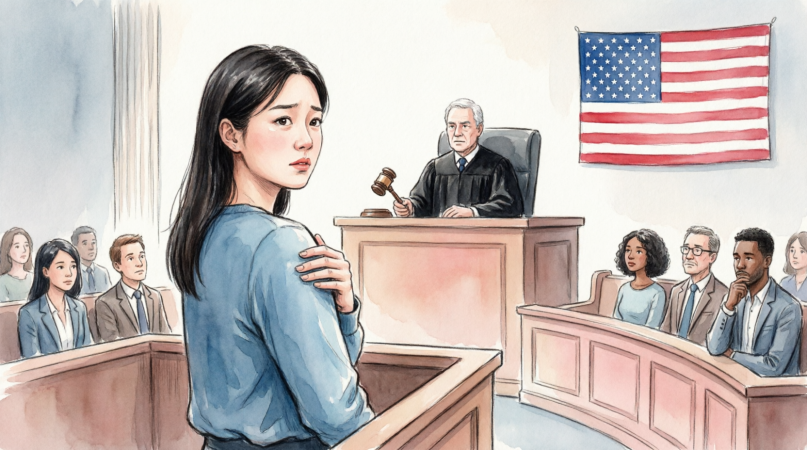
The Honorable Marissa Keane sat above us with the stillness of someone who had learned how to read a room without giving anything away.
Her silver-streaked hair was tucked neatly behind one ear, and her pen moved slowly across a yellow legal pad as my mother talked.
Every lie landed in the courtroom like a stone.
My older brother, Travis, sat behind our mother with his legs spread and one arm slung across the back of the bench.
He wore a camouflage jacket he had bought from a thrift store two days earlier.
He thought it was funny.
He thought everyone would understand the joke.
The joke was supposed to be me.
I was Harper Caldwell, thirty-four years old, eight years in the United States Army, former combat medic, honorably discharged, now working nights in a trauma ER outside Dayton.
I had carried men twice my size through smoke.
I had pressed gauze into wounds with hands that would not stop shaking until later.
I had learned how to keep my voice calm even when everything in front of me was coming apart.
And still, sitting in that courtroom, listening to my mother erase me, I felt like the little girl again.
The one who learned early that Linda Caldwell could make any room believe her.
Our town was small enough that everybody knew which church you attended, what car you drove, and how long your Christmas lights stayed up after New Year’s.
Reputation was not just important there.
It was social currency.
My mother guarded the Caldwell name like it was a holy relic, even though she was the person who had done the most damage to it.
When I enlisted at twenty, she told people I was being dramatic.
When I deployed, she told people I was probably sitting behind a desk somewhere.
When I came home different, quieter, thinner, and unable to stand fireworks, she told people I wanted attention.
Then my father died, and I stopped trying to make her love me correctly.
I stayed away from family dinners.
I stopped answering Travis’s drunk texts.
I let holidays pass without driving back to that house with its perfect white porch and its cold kitchen.
For the first time, my life got quiet enough that I could breathe.
My mother filled the silence with stories.
She told neighbors I had run away from responsibility.
She told cousins I had come home with fake heroic tales.
She told church ladies I was too embarrassed to show my face because everyone knew the truth.
The worst part was that I did not fight her.
Not publicly.
I had my DD214.
I had my medical records.
I had photographs, commendations, deployment paperwork, and letters from people who knew exactly where I had been.
But I kept them
in a fireproof box under my bed because I was tired of proving my life to people who wanted the lie more than the truth.
Then my grandfather died.
Grandpa Ellis had been my father’s father, and he had never been fooled by my mother’s performance.
He was not sentimental in the way people expect old men to be.
He rarely hugged.
He did not cry at graduations.
But when I came home from my second deployment and could not sleep in a room with the door closed, he quietly replaced the lock on his guest bedroom so it opened from both sides.
He never asked for details.
He just sat with me on the porch at three in the morning and handed me coffee like nightmares were weather, something you endured until the sky changed.
When his will was read, he left me his old house and a modest investment account.
It was not a fortune, but it was enough to change the direction of my life.
Enough to pay off debt.
Enough to let me stop renting.
Enough to give me one place in the world my mother could not enter and rearrange.
Linda Caldwell heard the will, smiled politely in the attorney’s office, and did not speak to me.
Two weeks later, I was served.
The petition accused me of fraud, defamation, elder manipulation, and misrepresenting myself as a veteran to gain sympathy from my grandfather.
It claimed Grandpa Ellis had been vulnerable and that I had exploited him with fabricated military stories.
It asked the court to declare my service claims false so the estate could be challenged under undue influence.
In plain English, my mother wanted the house.
And Travis wanted whatever cash came with it.
Their attorney, a pale man named Mr.
Rawlins who smelled like coffee and cologne, avoided my eyes when we first sat down in court.
That told me he had not seen everything.
Or maybe he had seen enough to know this was going to be uglier than his clients had promised.
My own attorney, Evelyn Park, leaned toward me before the hearing began.
‘You do not have to let them rattle you,’ she whispered.
‘I know,’ I said.
But my body did not know.
My pulse was steady because I had trained it to be steady.
My face was calm because I had learned calm in places where panic got people killed.
Under the table, though, my left shoulder burned the way it always did when rain was coming or when memory decided to put its hands on me.
The clerk called the case.
My mother rose like she had been waiting her whole life to be wronged in public.
She wore navy blue, pearls, and a small silver cross at her throat.
Her hair had been professionally curled.
She looked like every grieving mother from every church bulletin, every woman people instinctively believed because she knew how to tremble at the right moment.
When she took the stand and swore to tell the truth, I almost laughed.
Not because it was funny.
Because my body had no other place to put the insult.
Mr.
Rawlins began gently.
He asked her to describe her relationship with me, my alleged history of dishonesty, the way I had supposedly used stories
of service to gain attention.
My mother dabbed at her eyes with a tissue.
‘Harper has always been troubled,’ she said.
‘Creative, but troubled.
After her father passed, it became worse.
She started claiming things that simply were not true.’
‘What kind of things?’ Mr.
Rawlins asked.
She looked at the judge, not at me.
‘That she served overseas.
That she treated wounded soldiers.
That she was injured.
None of it happened.’
The courtroom was quiet except for the low hum of the air conditioner.
‘How can you be certain?’ he asked.
My mother straightened.
This was the line she had rehearsed.
‘Because she was here,’ she said.
‘People saw her.
Neighbors, relatives.
She came and went.
She hid from family events and then pretended those absences were deployments.
It was disgusting.’
Behind her, Travis nodded like a man hearing scripture.
Evelyn made a note, but she did not object.
Not yet.
Mr.
Rawlins continued.
‘Did she benefit from these claims?’
‘Yes,’ my mother said quickly.
‘My father-in-law adored veterans.
Harper knew that.
She manipulated him.
She made him believe she had sacrificed for the country.
That is why he changed the will.’
That was the first time my jaw tightened.
Grandpa had not loved me because of a uniform.
He loved me because he was the only person in that family who noticed when I was drowning and did not ask me to drown quietly.
Then my mother turned toward me.
Her mouth hardened.
‘She stole our family’s reputation,’ she said.
‘She made herself into some wounded hero so everyone would pity her.
But she never served in the military.
She made it all up.’
The words hung there.
I felt Travis watching me, waiting for tears.
He had always loved that part.
When we were kids, he would poke and poke until I finally snapped, then run to our mother with wide eyes and say, ‘See? Harper’s crazy.’ As adults, he had changed his clothes, his vocabulary, his targets.
But not the game.
Judge Keane finally lifted her gaze.
‘Mrs.
Caldwell,’ she said, ‘you understand that you are testifying under oath.’
My mother placed one hand over her heart.
‘I do, Your Honor.’
‘And you are stating, as fact, that your daughter did not serve in the United States Army.’
‘That is correct.’
The judge’s pen stopped moving.
Something in the room shifted.
I could not name it then.
It was not sympathy.
It was not suspicion.
It was more precise than that, like a lock finding the first tooth of the key.
Judge Keane turned to me.
‘Ms.
Caldwell,’ she said, ‘these are serious allegations.
Do you have proof of service?’
I heard my mother exhale through her nose.
She thought this was the trap.
She thought I would fumble through papers while she sat there in pearls, wounded and righteous.
She thought proof was something she could sneer at, something she could call forged, exaggerated, misunderstood.
‘Yes, Your Honor,’ I said.
‘I do.’
Evelyn opened the folder in front of her.
‘We have certified military personnel records, discharge papers, VA documentation, photographs, commendations, and medical records,’ she said.
‘We also have a witness available by phone if the court wishes to hear from him.’
Mr.
Rawlins went pale.
My mother’s tissue froze in her hand.
Travis
stopped nodding.
Judge Keane looked at the folder, then back at me.
‘Is there anything else?’
My shoulder burned again.
For ten years, I had kept that scar private.
I had hidden it under sleeves, under jokes, under silence.
Doctors had seen it.
A few nurses.
One man I almost loved.
My grandfather, once, when I forgot to pull my shirt down after changing the bandage during the first ugly months home.
My family had never seen it.
Maybe because they never wanted to see what their cruelty was asking me to prove.
I stood slowly.
‘Yes, Your Honor,’ I said.
‘There is something else.’
Evelyn touched my wrist.
Not to stop me.
To ask without words if I was sure.
I nodded.
The courtroom seemed to shrink around me.
I removed my blazer and laid it over the back of the chair.
The air felt cold against my arms.
I reached for the hem of my blouse near my left shoulder, where the fabric brushed the raised line that had become part of my body and yet never felt like mine.
‘Permission to show the court,’ I said.
Judge Keane’s expression tightened.
‘Proceed.’
I lifted the fabric just enough.
There was no drama in the scar itself.
That was what people never understood.
Real wounds do not glow with meaning.
They sit there, pale and uneven, a permanent interruption in the skin.
Mine ran from the top of my shoulder toward the collarbone, thick in one place, jagged in another, with smaller marks where surgeons had repaired what they could.
A sound moved through the gallery.
Not loud.
Not quite a gasp.
More like the room had forgotten to breathe and then remembered all at once.
My mother stared at it.
For the first time that morning, she did not look rehearsed.
Travis leaned forward, his mouth slightly open, the camouflage jacket suddenly ridiculous on his shoulders.
Judge Keane rose from the bench.
That was when everyone truly went silent.
Judges do not stand in the middle of testimony for no reason.
They do not abandon the cool height of the bench unless something has changed.
Her face had gone very still, but her eyes were fixed on my shoulder with a look I recognized from trauma bays and casualty tents.
Recognition.
Not of me.
Of the kind of mark that does not come from a childhood fall or a kitchen accident.
‘Ms.
Caldwell,’ she said carefully, ‘were you treated at Landstuhl Regional Medical Center in October of 2014?’
My breath caught.
The year flashed behind my eyes in white light and dust and shouting.
‘Yes, Your Honor,’ I said.
My mother turned sharply toward the judge.
Judge Keane looked down at the file Evelyn had submitted, then back at me.
‘And were you attached to the 3rd Brigade medical support unit during that deployment?’
‘Yes, Your Honor.’
The judge’s throat moved.
For a moment, she was not just a judge.
She was someone remembering.
‘Were you the medic who stabilized Captain Daniel Reece after the convoy incident outside Kandahar?’
The name hit me harder than my mother’s lies ever could have.
Danny Reece.
I had not heard it spoken in a courtroom voice before.
In my memory, it was shouted through dust.
It was printed on a blood-darkened……
name tape.
It was the name on a letter I had written and rewritten to his wife because no version sounded worthy of what had happened.
I lowered my shirt with trembling fingers.
‘Yes,’ I said, and my voice nearly failed.
‘I was one of the medics.’
Judge Keane sat down slowly.
The room remained frozen.
‘Captain Reece was my brother,’ she said.
A quiet sound came from somewhere behind me.
My mother’s face drained of color so quickly she looked ill.
I stared at the judge, unable to speak.
I remembered Captain Reece conscious when he should not have been, asking about his men.
I remembered telling him to keep his eyes on me.
I remembered lying with kindness because sometimes hope is the only tool left in your kit.
I remembered pressure, bandages, orders, heat, the metallic smell of fear.
I remembered my own shoulder burning and someone yelling that I was hit, and I remembered saying, ‘Not now.’
Not now, because Captain Reece was still breathing.
Judge Keane looked away first.
When she spoke again, her voice was controlled, but thinner than before.
‘For the record,’ she said, ‘I am disclosing a potential personal connection to testimony that has just been raised.
Counsel will approach.’
Both attorneys went to the bench.
My mother twisted in her seat, whispering urgently to Travis.
I heard only fragments.
‘She never said… how would I know… this is impossible…’
Travis whispered back, ‘Mom, shut up.’
That was new.
Evelyn returned to me after a brief conference and leaned close.
‘The judge is not recusing at this stage because the records stand independently, and neither side is requesting it,’ she said softly.
‘But Harper, listen to me.
This is over.’
It did not feel over.
My body still believed I was waiting for impact.
Judge Keane ordered my records admitted under seal, with redactions for privacy.
Evelyn handed certified copies to the clerk.
DD214.
Deployment orders.
Award documentation.
VA treatment summaries.
Medical records from Landstuhl.
Photographs of me in uniform with people whose names were stamped into the worst and proudest parts of my life.
Mr.
Rawlins flipped through the documents with the expression of a man watching the floor disappear beneath him.
‘Your Honor,’ he said, clearing his throat, ‘my clients were not aware—’
Judge Keane cut him off.
‘Your clients filed a petition alleging fraud.
Your clients placed specific factual claims before this court.
Your client has just testified under oath that Ms.
Caldwell never served in the military.’
My mother stood halfway.
‘Your Honor, I was misled.’
‘Sit down, Mrs.
Caldwell.’
She sat.
No one in my family had ever spoken to my mother like that and survived the dinner afterward.
The judge turned to Evelyn.
‘Does your client wish to be heard?’
Evelyn looked at me.
For years, I had imagined what I might say if I ever had a captive audience for the truth.
I thought it would be thunder.
I thought I would want to humiliate my mother the way she had humiliated me.
But when the moment came, I felt tired.
Not weak.
Just done carrying a burden that belonged to someone else.
I stood.
‘Your Honor,’ I said, ‘I did not want to bring my service into this family dispute.
I did not ask
for special treatment from my grandfather.
I did not ask him for the house.
He left it to me because he knew I needed one safe place to land.’
My mother made a small sound.
I kept going.
‘My family has called me a liar for years because it was easier than admitting they did not know me.
They mocked the years I was gone.
They mocked the parts of me that came back damaged.
I stayed quiet because I thought silence was dignity.’
My voice shook then, but it did not break.
‘But silence let them bring that lie into this courtroom.
So I am asking the court to dismiss their petition and protect my grandfather’s wishes.’
I sat down.
Judge Keane looked at my mother.
‘Mrs.
Caldwell,’ she said, ‘do you have any evidence supporting your claim that your daughter fabricated her military service?’
My mother’s mouth opened.
For once, no perfect sentence came out.
‘People said—’
‘Names,’ the judge said.
My mother blinked.
‘Neighbors saw her.’
‘Which neighbors?’
‘I would have to check.’
‘Dates?’
My mother looked at Travis.
Travis looked at the floor.
Judge Keane turned to him.
‘Mr.
Caldwell, you are also a petitioner.
Do you have evidence?’
Travis swallowed.
‘I believed my mother.’
Three words.
That was all it took for him to abandon her.
My mother stared at him like he had slapped her.
The judge was not moved.
She dismissed the petition with prejudice, which meant they could not simply refile the same poison in a different bottle.
She affirmed the validity of my grandfather’s will.
She ordered my mother and Travis to pay my attorney’s fees and court costs.
Then came the part my family had not expected.
Judge Keane referred the matter to the county prosecutor for review of possible perjury and filing false claims with the court.
She also ordered the transcript preserved and attached to the sanctions order.
In a town where reputation mattered more than truth, my mother’s lies were now part of a public record she could not charm, edit, or whisper away.
My mother stood up so fast her chair scraped the floor.
‘You cannot do this to me,’ she said.
Judge Keane’s eyes hardened.
‘Mrs.
Caldwell, I did not do this to you.’
The room went silent again.
‘You brought this case,’ the judge said.
‘You signed the petition.
You took the oath.
You chose to accuse your daughter of stolen valor without verifying the truth, and you did so in an attempt to undermine a lawful inheritance.
The consequences belong to you.’
My mother’s face crumpled, but it was not grief I saw there.
It was rage at being seen.
Travis would not look at her.
My relatives on the bench behind them stared straight ahead, each pretending they had not come to watch me be destroyed.
When court adjourned, I gathered my blazer with hands that felt strangely light.
Evelyn touched my shoulder, careful not to touch the scar.
‘You did well,’ she said.
I nodded because words were too far away.
At the aisle, my mother stepped in front of me.
For a second, I thought she might apologize.
Some foolish, bruised part of me still made room for it.
Instead she whispered, ‘You enjoyed that.’
I looked at her pearls,
her trembling mouth, the woman who had mistaken my restraint for weakness for most of my life.
‘No,’ I said.
‘I survived it.’
Then I walked past her.
Outside the courthouse, the Ohio sky was gray and low, the kind of sky that pressed down on everything but did not quite rain.
I stood on the steps and breathed air that did not belong to a hospital, a battlefield, or my mother’s house.
Judge Keane never spoke to me privately.
She could not, and I respected that.
But as I reached the bottom step, an older man in a worn suit approached me.
He introduced himself as Daniel Reece’s father.
He had been sitting in the back the entire time.
‘I came because Marissa told me there was a hearing involving a medic from Danny’s unit,’ he said, his voice rough.
‘I did not expect it to be this.’
He held out his hand.
I took it.
He did not say thank you right away.
Maybe he knew those words were too small.
Instead, he squeezed my hand with both of his and said, ‘My son came home long enough for his wife to say goodbye because of you.’
That was when I finally cried.
Not in the courtroom.
Not when my mother lied.
Not when the scar was exposed.
I cried on the courthouse steps because a stranger gave me back a piece of the truth my own family had tried to steal.
In the months that followed, the sanctions order hit my mother harder than the money ever could.
People read it.
People talked.
The same neighbors she had fed stories to began crossing grocery aisles to avoid her.
Travis tried to apologize through text, but every message began with an excuse, so I stopped reading them.
The prosecutor eventually charged my mother with misdemeanor perjury connected to her sworn statements.
She took a plea, paid a fine, and received probation.
It was not prison.
It was not cinematic.
But it was official, stamped, filed, and impossible for her to turn into gossip.
I moved into Grandpa’s house that autumn.
The porch still creaked in the same place.
The kitchen window still stuck when the weather changed.
In the upstairs bedroom, I found an envelope taped to the back of a drawer.
Inside was a note in my grandfather’s blocky handwriting.
Harper, if they ever make you prove who you are, remember that the truth does not become smaller because cruel people refuse to hold it.
I framed that note and hung it in the hallway.
My medals stayed in the shoebox.
My records went back into the fireproof safe.
I did not suddenly become a person who wanted to tell war stories at dinner tables.
But I stopped hiding from my own life.
Sometimes people think the cruelest betrayal is being called a liar.
It is not.
The cruelest part is realizing someone would rather destroy your name than admit they never cared enough to know your story.
My mother wanted the court to punish me for surviving in a way she could not control.
Instead, the court made her answer for the lie.
And even now, people still argue about whether I should have exposed the scar in front of everyone, whether the judge was too
harsh, whether a daughter owes mercy to a mother who tried to erase her.
I only know this: forgiveness may be holy, but truth is sometimes the first safe place a person gets to stand.